Tracked or wheeled: which mower actually holds a slope
Tracked or wheeled: which mower actually holds a slope
Tracks and wheels fail in different ways. What a wheel does on a bank, what a track does instead, and the five numbers to measure before you choose a mower.
Every buyer of a remote control mower eventually asks whether tracks are better than wheels. It is the wrong question, and it is why so many people end up with the wrong machine. Tracks and wheels do not fail in the same way, so the honest question is simpler: what will fail first on your ground?
On flat, dry, open grass a wheeled machine is faster, cheaper and kinder to the turf. Nobody who builds tracked mowers should pretend otherwise. On a bank, in a ditch, or on ground that is soft under the surface, a wheel lets go long before a track does. That is the only reason the tracked format exists.
Two different ways to lose grip
A wheel and a track both rely on friction between rubber and ground. The difference is how much rubber is in contact, and what happens when it stops being enough.
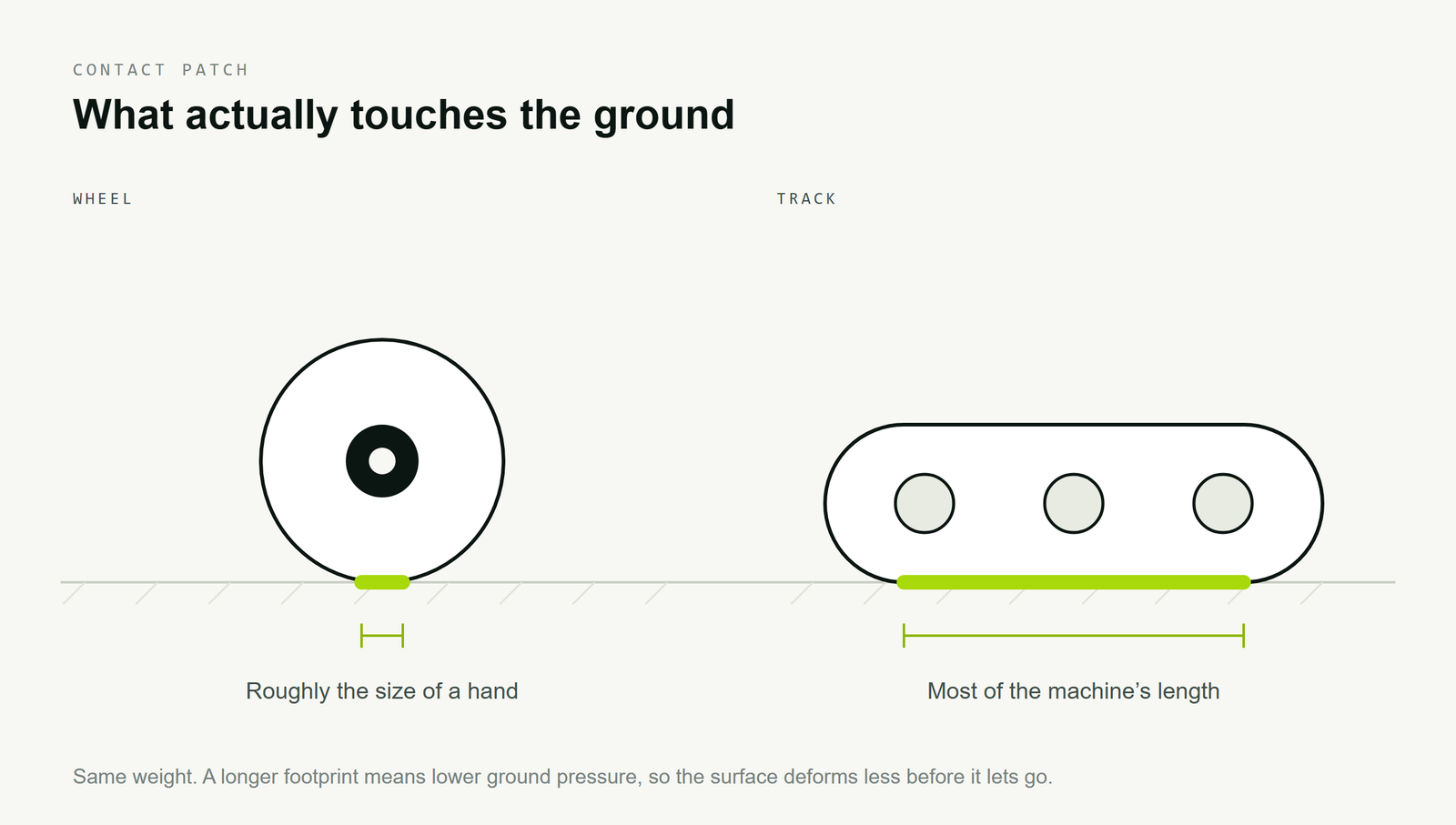
A wheel has a contact patch roughly the size of your hand. A track has a contact length running most of the machine. That single geometric difference explains almost everything that follows.
What a wheel does on a slope
Put a wheeled machine across a slope and three things happen at once. The weight shifts to the downhill side, the contact patch deforms, and the tyre starts to slide sideways rather than roll. Once it slides, steering does nothing, because steering only works while the tyre is gripping.
On dry grass this happens at a surprisingly shallow angle. On wet grass it happens almost immediately. The failure is not dramatic — the machine does not usually tip. It simply stops going where it is pointed, which on a bank is worse, because the operator is standing downhill of it.
This is why ride-on mowers are not used on embankments, and why the operators who do it anyway have a story about the one time it went wrong.
What a track does instead
A track spreads the same weight over a much longer footprint. Lower ground pressure means less sinking, and the grousers bite into the surface instead of relying on pure friction. When a track does break away, it usually does so gradually and in a straight line, which gives the operator time to react.
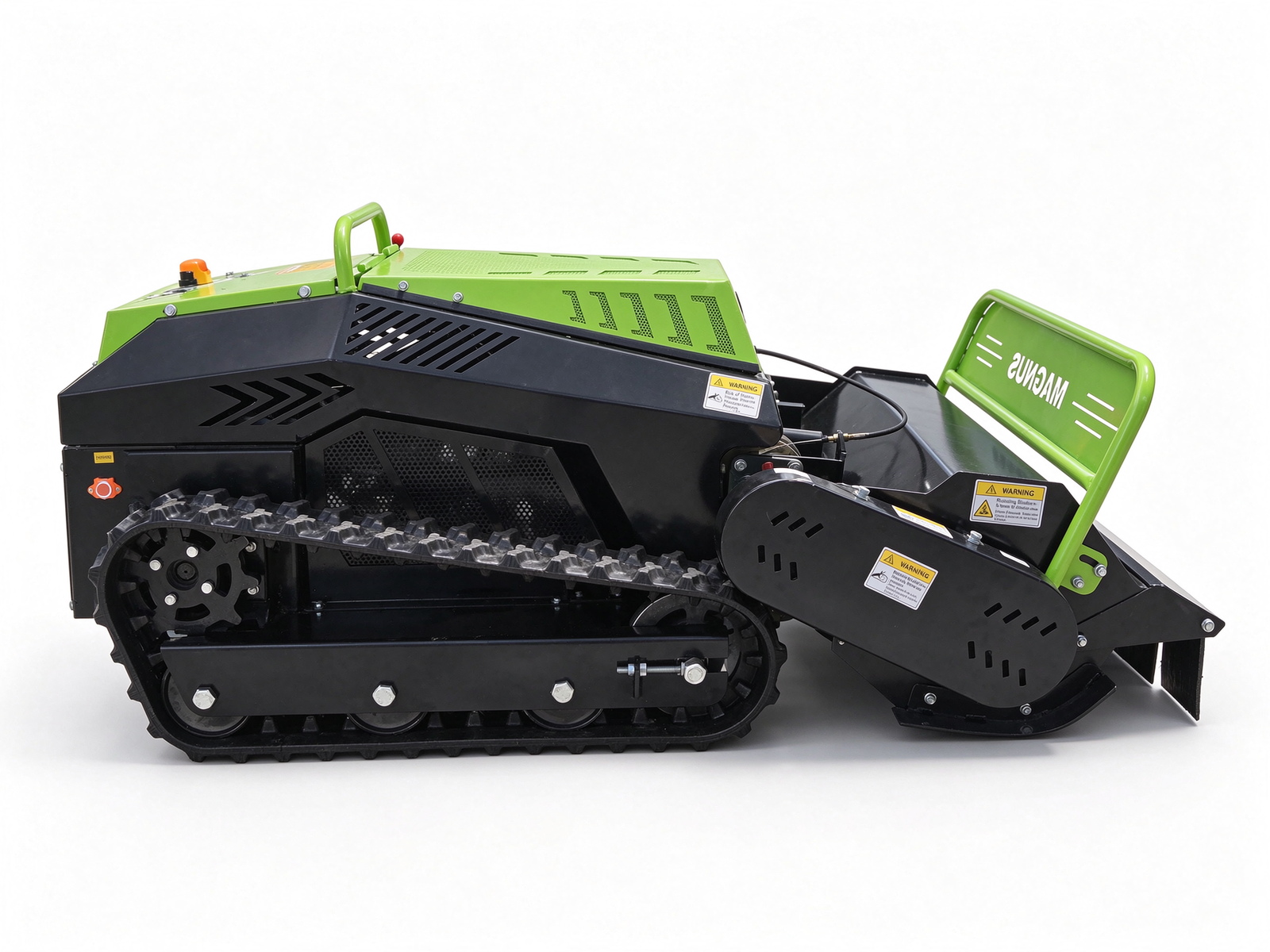
Two independent drive motors matter as much as the track itself. With a motor on each side, a turn is a speed difference rather than a steering angle, so the machine can pivot on the spot at the top of a bank instead of making a three-point turn with half its weight over the edge. Every model in the MAGNUS range is built this way.
The number on the brochure
Slope ratings are the most abused figure in this category, in both directions. Some suppliers print a number measured once, on a dry day, with a fresh track and no load. Others print a conservative number and lose sales to the first group.
Every MAGNUS model is rated to 45 degrees in all directions on firm, dry ground. That is the working limit and we will stand behind it. What changes is not the machine but the surface: wet clay, loose scree and soft peat break the tracks away well before the deck reaches its angle limit, and on saturated clay no tracked machine holds 45 degrees.
It is worth separating two things that get confused in sales conversations. A slope rating is a marketing figure — no regulation governs it. What is regulated is the machine itself: Directive 2006/42/EC covers the guards, the emergency stop and the documentation that has to come with a machine sold in Europe. Ask for both, and treat the second one as the more important.
The comparison, in one table
| Criterion | Wheeled | Tracked |
|---|---|---|
| Grip on a wet slope | Lets go early; slides sideways | Holds until the surface itself fails |
| Speed on flat open ground | Faster | Slower, but not by much on rough ground |
| Turf damage | Lower on soft turf | Higher turning load; 140 to 360 kg on two tracks |
| Purchase and running cost | Lower | Higher; tracks, rollers and drive motors cost more |
| Transport | Drives itself onto a trailer | Needs a trailer and a ramp |
| Where it belongs | Lawns, flat pasture, open amenity grass | Banks, ditches, verges and embankments, orchards and pasture with slope |
Where wheels still win
It would be dishonest to end the comparison there.
- Speed on open ground. A ride-on or a towed mower covers flat pasture faster. Tracks are not a speed advantage; they are a grip advantage.
- Turf damage. A 360 kg tracked machine turns harder than a 200 kg ride-on. On a lawn in February it will leave a mark the ride-on would not.
- Purchase and running cost. Tracks, rollers and drive motors are more expensive to buy and to replace than tyres.
- Transport. A tracked machine needs a trailer and a ramp. A ride-on drives itself onto one.
If your ground is flat, dry and open, wheels are the correct answer and no amount of track marketing changes that.
What to measure before you choose
Five numbers, all of which you can get with a phone, a tape and a wet day:
- The steepest ten metres, not the average of the face. Averages hide the part that matters.
- The surface at its worst, not at its best. Walk it in February, not July.
- The narrowest gap on the route in, including the gate.
- The run-off at the crest — where the machine turns, and what is behind it.
- What is buried: drainage, cable, irrigation line. A track finds all three.
If you only measure one thing, measure the surface on a wet day. Every slope rating in this industry assumes a dry surface, and most sites are not dry for half the year. Where the site is a workplace rather than a garden, the UK guidance on vehicles and machinery on farms is a reasonable structure for the risk assessment, even outside the UK.
When the answer is neither
There are sites where no machine of this class belongs. Above roughly 45 degrees on soft ground, or on a face with a loose top layer over hard subsoil, the honest recommendation is a different method entirely: rope access, a winched machine, or leaving the vegetation in place because it is what holds the bank together.
That work is planned like working at height, not like mowing. The HSE agriculture guidance is where most of the UK framing for it comes from, and the logic travels: assess the surface, plan the line, and never put a person below the machine.
We would rather lose the order than sell a machine into a bank it cannot hold. A mower that slides into a ditch is a warranty claim. A mower that slides into a road is something else entirely.
The short version
Tracks are not better than wheels. They are better at one specific thing: keeping grip when the surface stops cooperating. If your ground is flat and dry, buy wheels. If it is not, the question becomes which track, which deck and which weight — and that is a conversation about your site, not about a brochure.
If the growth is woody rather than grassy, the deck matters as much as the drive: a flail rotor shears, a rotary blade batters, and the difference shows up six weeks later as regrowth.
Send us the slope, the surface and the narrowest gap. We will tell you which model fits, and if the answer is that none of them do, we will tell you that too.
Related guides
Read next
When to sharpen remote control mower blades
How to tell a dull blade from a damaged one, the three signs a remote control mower blade is past…
EU Machinery Regulation 2023/1230: what changes in January 2027
The EU Machinery Regulation replaces the old directive on 20 January 2027. What changes for remote control mowers, and what…
Remote control mower safety: what goes wrong
Losing sight of the machine, slope slip, thrown objects and hydraulic injection. What goes wrong on remote mowers and how…
Send the slope. We will confirm the model.
Tell us the gradient, the area and the nearest port. We reply with a model and a landed cost within one business day.