When to sharpen remote control mower blades
When to sharpen remote control mower blades
How to tell a dull blade from a damaged one, the three signs a remote control mower blade is past sharpening, and why flail blades get replaced.
The question of when to sharpen remote control mower blades is usually answered a season too late, after months of ragged tips and a deck that shakes. Putting an edge back on steel is a short job at a bench. Knowing that the edge has stopped earning its keep is the part that decides whether you lose twenty minutes or a morning.
Two faults get confused here. A dull blade and a damaged blade need different treatment, and one is not a sharpening job at all. The sections below separate them, then cover what to check before the deck goes back on.
Two deck types, two different wear stories
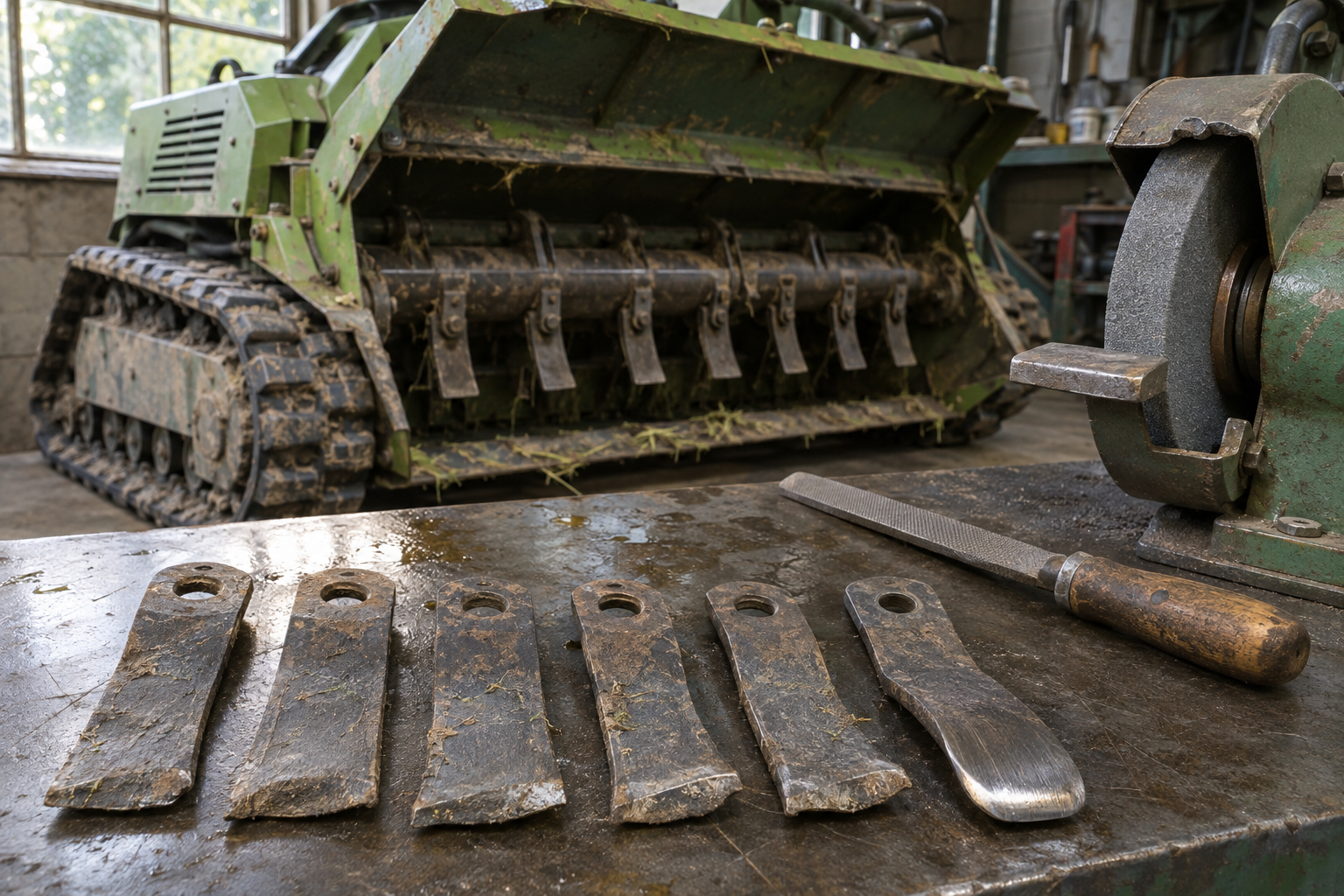
The range splits on blade count, and that split matters more than any other specification when you decide what to do about a dull cut. The 500 mm and 800 mm lawn decks carry two swing blades on a bar. The 800 mm and 1,000 mm flail decks carry 54 or 66 individual blades on a rotor. A bar blade presents one long edge and is ground back on a bench. A flail blade presents a short edge, is thin, and is normally replaced rather than ground, because grinding one back takes off more metal than the blade has to spare. A rotor row of 66 only cuts cleanly while its blades hang at a consistent length.
That is why a two-blade deck can stay on one set of blades for years and a flail deck cannot. A bar blade dulls across its whole length and the cut goes soft everywhere at once. A flail rotor loses its cut unevenly, a few blades at a time, and the machine keeps working while it does. The finish tells you, if you look at the tips rather than the whole strip — two blades or a 66-blade rotor behave quite differently here.
The table below sets out what each deck is asked to do. Cut height belongs here because a deck set low meets more grit and soil, and grit is the fastest thing that takes an edge off.
| Model | Cut width | Blades | Cut height | Edge treatment |
|---|---|---|---|---|
| MA-50P | 500 mm | 2 | 30–130 mm | Bar blade, ground back |
| MA-80P | 800 mm | 2 | 30–130 mm | Bar blade, ground back |
| MA-80-1 | 800 mm | 54 | 20–250 mm | Flail blades, replaced in rows |
| MA-80-SA | 800 mm | 54 | 20–200 mm | Flail blades, replaced in rows |
| MA-100 | 1,000 mm | 66 | 20–250 mm | Flail blades, replaced in rows |
| MA-100-1 | 1,000 mm | 66 | 20–250 mm | Flail blades, replaced in rows |
| MA-100-2 | 1,000 mm | 66 | 10–300 mm | Flail blades, replaced in rows |
What actually wears an edge
Grass is abrasive. Leaf carries silica, and an edge that spends its life in contact with it is polished away rather than chipped. The rate depends far more on what you are cutting than on hours run, which is why the two decks above wear on different schedules.
Soft spring grass on a lawn deck is gentle work. Dry summer stalks, gorse and bracken are not: the stems are woody, they run up to 40 mm across, and a rotor meets them at speed with a short edge and little material behind it. Grit is worse than either. A deck set low on dry, stony ground, or run along the edge of a gravel track, will lose its edge faster than one working clean grass at 200 mm.
No hour count predicts this honestly, and a blade service interval quoted in hours is worth distrusting. The edge is the instrument. Read it.
The three signs it is past sharpening
The cut tip frays. Look at the tip of a single leaf after a pass, not at the sward from a distance. A sharp blade severs; a dull one tears, and a torn tip goes pale within a day. On a flail deck the same fault shows as a bruised, shredded finish, because the rotor is mulching as much as cutting.
The edge is rounded, not nicked. Hold the blade in raking light. Wear produces a polished radius along the whole edge, and you feel it before you see it. A notch is something else, covered below. If the radius is wide enough to catch a fingernail, that blade has stopped cutting and started burnishing.
The deck sounds different. A bar blade worn unevenly, or one end worn harder than the other, sets up a vibration you feel through the frame before you hear it. On a flail rotor, a broken or missing blade does the same thing more sharply. Vibration is the point at which sharpening has become a balance question, and balance is not something a file can fix.
Impact damage is not wear
Stones, wire, fence staples, brick and buried scrap do not dull an edge, they remove part of it. The distinction is easy once you know to look. Wear is smooth and gradual along the edge. Impact is discrete: a notch, a bent blade, a cracked eye, a hanger that no longer hangs square.
The two need opposite responses. A worn edge is sharpened or replaced as routine. A damaged blade comes off. A bar blade ground back far enough to erase a notch has lost its shape and its balance, and a bent one is replaced rather than straightened. On a flail deck, a blade that has lost its shoulder is a replacement item.
This is also the moment to look at what the blade hit. A deck taking repeated strikes in the same place is usually set too low for the ground under it, and the next set of blades will fail in the same spot.
Isolate the machine before any of this: engine off, handset switched off and set down away from the deck, rotor at rest. The 2.4 GHz link stops the deck when the signal drops, which is a useful behaviour and not a lockout, and a handset in a pocket is not isolation. Reaching into an exposed deck is the part of mower maintenance that injures people; the HSE agriculture guidance treats guarding and maintenance access as one problem, not two.
Sharpening a two-blade deck
A bar blade is straightforward if you resist two temptations: taking off too much metal, and changing the angle.
Match the bevel that is already on the blade. A few passes with a file, in one direction, along the existing face, brings back a working edge. A bench grinder removes metal faster than most people intend and heats the edge while it does. Work both ends of the bar equally, then compare them by eye and by hand; a bar that is sharp at one end and slightly heavier at the other will vibrate.
Check the blade for cracks at the eye before it goes back on, and check its bolt and washer. A stretched or corroded fixing is replaced, not reused, and the tightening figure comes from the operating manual shipped with the unit in its CE documentation, not from a general table.
If the blade has been ground back repeatedly, the bar is lighter and narrower than it was designed to be. At that point a new pair is the cheaper answer, and the cut improves.
A 54 or 66-blade rotor
Flail blades are consumables. They are thin, they work at speed, and they are meant to be swapped rather than restored. Two habits make the difference between a rotor that cuts and one that shakes.
First, replace in rows rather than singly wherever you can. A rotor carrying a few new blades among worn ones cuts unevenly and balances unevenly. Second, check the hangers as you go: a blade that swings stiffly, or hangs at a different angle from its neighbours, is a hanger fault and will wear the next blade out early.
Keep one spare set on the shelf. That is the difference between losing an afternoon and losing a week on a contract, and a set of blades is a small item against the cost of a stopped job. The intervals around this work sit inside the full maintenance schedule.
The check most people skip
With the deck back together, turn the rotor through a full revolution by hand before the engine is started. You are listening for interference, feeling for a tight spot, and confirming that nothing fouls the housing.
Then set the cut height and run the first strip on flat, dry, open ground rather than a bank. Read the tip of the grass, not the strip. The 45° capability of these machines applies to firm, dry ground in all directions; wet clay is a traction limit rather than an angle limit, and a first test cut is the wrong place to discover that.
If the finish is still ragged after a fresh edge, the blade was not the fault. It is cut height, forward speed or a deck not sitting level, and those are worked through in order. The EU Machinery Regulation expects maintenance and guarding instructions to travel with the machine, and the UK guidance on farm vehicles and machinery sets out what a maintenance routine should cover.
If you are unsure whether a blade is worn or damaged, photograph the edge in daylight and send it over. Telling the two apart usually takes less time than ordering the wrong part, and there is no charge for the question. The contact page has the address and the phone number.
Related guides
Read next
Tracked mower track tension: how to read the wear
How to check tracked mower track tension by hand, what a slack track sounds like, and the wear pattern that…
Tracked or wheeled: which mower actually holds a slope
Tracks and wheels fail in different ways. What a wheel does on a bank, what a track does instead, and…
EU Machinery Regulation 2023/1230: what changes in January 2027
The EU Machinery Regulation replaces the old directive on 20 January 2027. What changes for remote control mowers, and what…
Send the slope. We will confirm the model.
Tell us the gradient, the area and the nearest port. We reply with a model and a landed cost within one business day.