EU Machinery Regulation 2023/1230: what changes in January 2027
EU Machinery Regulation 2023/1230: what changes in January 2027
The EU Machinery Regulation replaces the old directive on 20 January 2027. What changes for remote control mowers, and what dealers should ask suppliers now.
On 20 January 2027 the EU Machinery Regulation (EU) 2023/1230 replaces the Machinery Directive that has governed equipment sales in Europe since 2009. For anyone importing remote control mowers from China, the date matters for one practical reason: the declaration of conformity attached to a machine has to match the law in force on the day it is placed on the market. Not the day it was ordered. Not the day it was built.
That single rule creates a paperwork gap of roughly four months for stock ordered now. This article covers what changes, which obligations land on the importer rather than the factory, and the questions worth asking a supplier before signing a 2027 delivery.
What actually changes on 20 January 2027
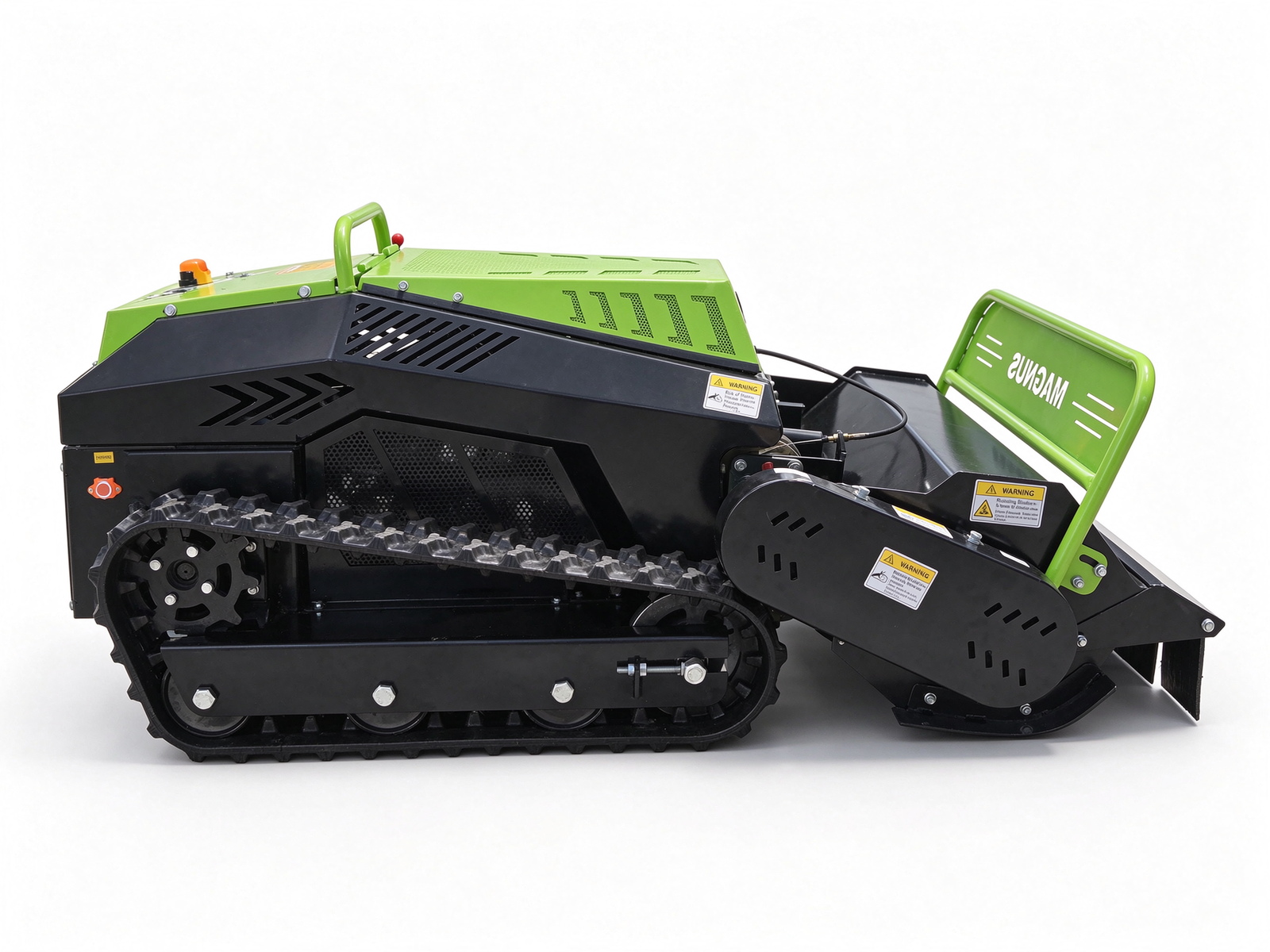
The shift from a directive to a regulation is the part most buyers skim past, but it changes how compliance works in practice.
A directive sets a result that each member state must turn into its own national law. Countries do this at different speeds and with different wording, which is why the same machine could be read slightly differently in Poland and in Portugal. A regulation applies directly across the whole EU without any national translation step. The grey zones that came from twenty-seven separate interpretations largely disappear.
For a manufacturer, this means the technical file has to stand on its own. You can no longer rely on a national authority reading a requirement generously.
The second change is the cut-off rule. Machinery placed on the EU market before 20 January 2027 is assessed against Directive 2006/42/EC. Machinery placed on the market on or after that date is assessed against the Regulation. Placing on the market means the moment the machine is made available for the first time in the EU, which for imported goods is normally when it clears customs and enters free circulation, not when the purchase order was signed.
Three new obligations that catch remote mower suppliers out
1. AI systems are now named explicitly
The old directive was written before machine learning existed in anything smaller than a research lab. The new regulation addresses AI systems used in machinery safety functions directly.
Most remote control mowers on the market today are not affected, because the operator drives every movement and there is no autonomous decision layer. The moment a supplier adds automatic row following, obstacle avoidance, or terrain-adaptive speed control, the assessment changes. If a dealer is being offered a “self-driving” or “auto-steer” version, that is the point to ask which conformity route was used.
2. Cybersecurity is inside the scope
A machine connected to a network now has to be assessed for risks that come through that connection. A remote control mower with a radio handset is not a networked device in the usual sense, but models with GPS tracking, SIM-based telematics or app control fall closer to the line.
This overlaps with the Cyber Resilience Act, which phases in over 2027 and 2028. Suppliers selling connected equipment into Europe will be dealing with both.
3. Digital instructions are allowed, with a condition
Paper manuals are no longer mandatory for every machine. Digital instructions are permitted, but the regulation keeps a route to a paper copy: the user must be able to request one, and in some cases a paper version still has to accompany the machine.
For exporters this is a small cost saving and a small risk. A PDF manual that is not maintained as the machine changes becomes a compliance problem rather than a convenience.
The four pieces of legislation that already apply
The Machinery Regulation is not the only file a remote control mower needs. A tracked mower with a wireless handset typically sits under four separate instruments, and a supplier who only mentions CE in general terms is usually missing two of them.
| Legislation | What it covers | What the dealer should receive |
|---|---|---|
| Machinery Regulation (EU) 2023/1230 | The machine itself, its guarding, controls and stability | Declaration of conformity, technical file reference |
| Radio Equipment Directive 2014/53/EU | The wireless handset and receiver | RED conformity statement, frequency and power details |
| Outdoor Noise Directive 2000/14/EC | Guaranteed sound power level | Sound power value and the marking on the machine |
| RoHS 2011/65/EU | Restricted substances in electrical components | Material declaration or test report |
Dealers who have bought from Chinese factories before will recognise the pattern. The machinery certificate is usually supplied. The radio equipment statement is often missing, and the noise marking is frequently wrong or absent on smaller models.
We covered the certification structure in more detail in the CE marking guide for remote control mowers.
If you import from China, part of this is now your obligation
The regulation separates duties by role, and importers carry more of them than most first-time buyers expect.
- Verify the manufacturer has run a conformity assessment and holds a technical file. You are not required to redo the assessment, but you are required to have checked that it exists.
- Keep the declaration of conformity for ten years and be able to hand it to a market surveillance authority on request.
- Put your own name and address on the machine if you are the importer placing it on the market under your brand.
- Store and transport correctly, and not alter the machine in a way that changes its conformity.
- Report incidents that fall within the regulation’s scope.
None of this is difficult if the supplier provides a complete file at the point of shipment. It becomes expensive if the file arrives incomplete and a shipment is held at customs while documents are chased from another continent.
Seven questions to put to a supplier before a 2027 order
These are the questions that separate a supplier who has read the regulation from one who has only heard the date mentioned.
- Will the declaration of conformity for this model cite Regulation (EU) 2023/1230, or the old directive, for a shipment arriving after 20 January 2027?
- Which notified body was involved, if any, and for which assessment module?
- Can you send the full technical file index, not just the certificate?
- Does the radio handset have its own RED conformity statement, and what frequency band does it use?
- What guaranteed sound power level is marked on the machine, and does it match the noise directive declaration?
- If the model has GPS, telematics or app control, what cybersecurity assessment has been carried out?
- What happens to machines shipped in December 2026 that clear customs in February 2027?
Question seven is the one that costs money. A container loaded in December and cleared in February is assessed under the new regulation, even though the order and the invoice belong to the old regime. Either the ship date moves earlier, or the paperwork is prepared for the new regulation in advance.
Where dealers get caught out
Three patterns come up repeatedly in this transition.
Stock in transit. As above, the customs clearance date decides, not the invoice date. Dealers planning a Q1 2027 delivery should confirm with their forwarder when the goods will actually enter free circulation.
Spare parts and partly completed machinery. A deck assembly or a hydraulic unit shipped separately has its own documentation requirements. A machine that was compliant as a whole does not automatically make its sub-assemblies compliant when sold on.
Software updates after delivery. If a supplier pushes firmware to a connected machine after it has been placed on the market, the question of who owns that change and whether it affects conformity is unresolved in most dealer contracts. It is worth writing into the supply agreement now rather than in 2028.
Frequently asked questions
Does a remote control mower need a notified body under the new regulation?
Most models do not. Self-propelled machinery that is not in the higher-risk list can usually be self-assessed under the internal production control module. A notified body is required for specific categories such as certain woodworking machinery and presses. If a supplier claims a notified body certificate for a standard slope mower, it is worth asking which module and which body.
Can I still sell old-directive stock after January 2027?
Yes, if it was placed on the EU market before 20 January 2027. Machines already in free circulation can continue to be sold. The rule applies to the moment of placing on the market, not to the moment of the retail sale. Keep the customs entry documents, because that is the evidence that decides which regime applies.
Does the new regulation change the machine itself?
Not usually. The essential health and safety requirements are largely carried over. What changes is the assessment process, the documentation, and the explicit coverage of AI and cybersecurity. A mower that was compliant in 2026 is unlikely to need mechanical changes in 2027, but its file will need updating.
What to do next
If you are planning stock for the first half of 2027, the practical sequence is: confirm the clearance date with your forwarder, then confirm with your supplier which regulation the declaration of conformity will cite. Those two dates decide everything else.
If you are still choosing a model, the slope and area selector narrows the range in about a minute. For dealer and OEM enquiries, the dealer programme page sets out minimum order quantities, territory availability and what documentation comes with each shipment.
You can also ask us directly for the current documentation set on any model, including the MA-100-2, and we will tell you exactly what is issued and what is still in preparation. A straight answer on that question is more useful than a certificate with a date that does not match your shipment.
If you are sizing a machine for a specific site, send the slope, the surface and the narrowest gap on the route in. We will tell you which model fits, and if none of them do, we will tell you that too. Request a quote.
Related guides
Read next
Tracked mower track tension: how to read the wear
How to check tracked mower track tension by hand, what a slack track sounds like, and the wear pattern that…
When to sharpen remote control mower blades
How to tell a dull blade from a damaged one, the three signs a remote control mower blade is past…
Tracked or wheeled: which mower actually holds a slope
Tracks and wheels fail in different ways. What a wheel does on a bank, what a track does instead, and…
Send the slope. We will confirm the model.
Tell us the gradient, the area and the nearest port. We reply with a model and a landed cost within one business day.