Remote Control Mower Maintenance Schedule
Remote Control Mower Maintenance Schedule
A maintenance schedule by engine hour: blades, hydraulic oil, track tension and battery, from the 8-hour check to the 500-hour service.
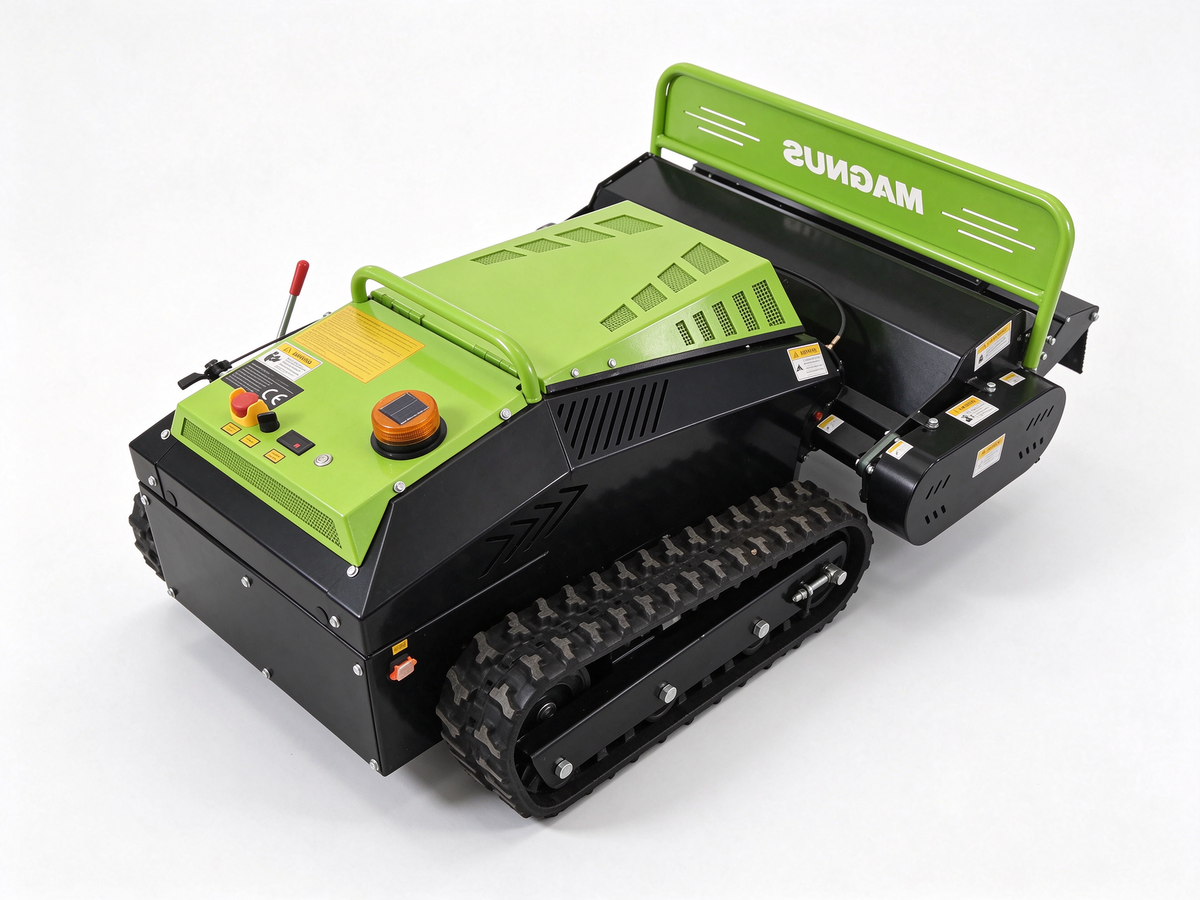
A tracked remote control mower fails in predictable ways. Blades wear, hydraulic oil degrades, track tension drifts, and batteries sulphate. All four are cheap to catch early and expensive to catch late.
This schedule is organised by engine hours rather than calendar time, because that is what the machine actually experiences. A machine doing 200 hours a year needs the same 250-hour service as one doing 800 hours, just later.
The schedule
| Interval | What to do | Why it matters |
|---|---|---|
| Before every session | Walk around the deck; check for missing or bent blades; check track tension by eye; check hydraulic hoses for weeping | A missing blade unbalances the rotor and destroys the bearing within hours |
| Every 8 hours | Clean the deck underside; check engine oil; check air filter; grease the deck pivot points | Packed grass holds moisture and corrodes the deck |
| Every 50 hours | Engine oil change; clean or replace air filter; inspect track tension properly; check battery terminals | The first oil change is the most important one on a new machine |
| Every 100 hours | Replace engine oil and filter; inspect hydraulic oil level and colour; check all hydraulic hose fittings; inspect track for cuts and missing grousers | Hydraulic oil that has turned dark is already doing damage |
| Every 250 hours | Hydraulic oil and filter change; replace spark plug; check valve clearance; inspect drive sprocket teeth; check remote control range | Hydraulic oil is the single most neglected item on these machines |
| Every 500 hours | Replace hydraulic hoses as a set; rebuild or replace rotor bearings; replace track if grouser height is worn; full hydraulic system flush | Hoses fail from the inside out. By the time you see a bulge it is overdue |
| Annually, regardless of hours | Battery load test; replace fuel lines if cracked; full fastener torque check; repaint any bare metal on the deck | Batteries age by time as well as cycles |
Blades: the highest-frequency cost
The 800 mm and 1,000 mm models carry 54 and 66 individual blades respectively; the P-series machines use a two-blade deck. That difference changes the maintenance economics more than any other specification.
On a spade rotor, individual blades are consumable and cheap. Inspect before every session and replace any that are bent, cracked or missing. A rotor running with an unbalanced blade set will destroy its bearing, a repair that costs many times a blade set.
On a two-blade deck, blades can be sharpened rather than replaced, and a sharp blade cuts cleaner and loads the engine less. Sharpening two blades takes less time than replacing ten.
When to replace rather than sharpen
- A crack anywhere, however small, replace immediately, do not sharpen
- More than a few millimetres removed from the cutting edge, the blade has lost its hardened zone
- Any bend is a fatigue failure waiting to happen
- Heavy impact damage from stone or wire, replace the set rather than the damaged blade
Hydraulics: the expensive neglect
Hydraulic oil does three jobs: transmits force, lubricates the pump and motors, and carries heat away. When it degrades, all three suffer and the failure is not gradual. A pump can go from noisy to seized in a day.
Check the oil on the dipstick at 100 hours. Healthy hydraulic oil is translucent amber. Dark, cloudy or milky oil means either overheating or water ingress, and both require a change plus a check of the breather.
Replace hoses on the 500-hour interval as a set rather than one at a time. Hoses age together, and a hose that fails in the field on a slope is a recovery problem, not just a repair.
Tracks: tension and wear
Track tension that is too loose causes the track to derail on turns. Too tight wears the sprocket and the idler bearings. Check it at 50 hours and adjust to the manufacturer’s specification, measured as deflection at the mid-point of the track run.
Watch grouser height. As the steel grousers wear down, traction on wet grass falls away long before the track looks worn out. A track at half its original grouser height is a track that will slide on a slope it used to hold.
Battery and remote
The battery on these machines powers the electric start, the hydraulic lift actuator and the control system, not the drive. It is a small battery doing a small job, which is why it often fails unnoticed until the machine will not start on a cold morning.
Load test it annually. Keep the terminals clean and greased. If the machine is stored for more than two months, put it on a maintenance charger rather than leaving it flat.
Test the remote range at the 250-hour service. Walk the machine out to its normal working distance and confirm the controls respond without delay. Range falls off gradually as the antenna and receiver degrade, and operators compensate without noticing until the machine stops responding on a slope.
Winter lay-up
- Wash the deck thoroughly. Grass holds moisture and salt against bare metal
- Run the engine dry or add fuel stabiliser; ethanol-blend petrol degrades in storage
- Change the engine oil before storage, not after. Acids in used oil attack bearings over winter
- Grease all pivot points
- Remove the battery and store it indoors on a maintenance charger
- Relieve hydraulic pressure and store the deck lowered, not raised
- Cover the machine; a breathable cover, not a plastic sheet that traps condensation
Frequently asked questions
How often should I change the hydraulic oil?
Every 250 hours, or annually if the machine does fewer hours than that. The annual change matters because oil absorbs moisture over time even when the machine is idle.
Can I use ordinary engine oil in the hydraulics?
No. Use the hydraulic oil grade specified for the machine. Engine oil lacks the anti-wear additives and viscosity index that hydraulic systems need, and the cost difference is trivial against a pump replacement.
How long do the tracks last?
It depends almost entirely on surface. Rubber tracks on grass and soft ground last far longer than the same track on gravel, concrete or sharp rock. Inspect grouser height at every 100-hour service rather than working to a fixed replacement interval.
Ask for the service schedule for your model
We can send the full maintenance schedule and the consumable parts list for any model in the range, so you can stock the right spares before the season starts.
Related guides
Read next
When to sharpen remote control mower blades
How to tell a dull blade from a damaged one, the three signs a remote control mower blade is past…
Tracked or wheeled: which mower actually holds a slope
Tracks and wheels fail in different ways. What a wheel does on a bank, what a track does instead, and…
EU Machinery Regulation 2023/1230: what changes in January 2027
The EU Machinery Regulation replaces the old directive on 20 January 2027. What changes for remote control mowers, and what…
Send the slope. We will confirm the model.
Tell us the gradient, the area and the nearest port. We reply with a model and a landed cost within one business day.