Orchards, vineyards, pasture, margins
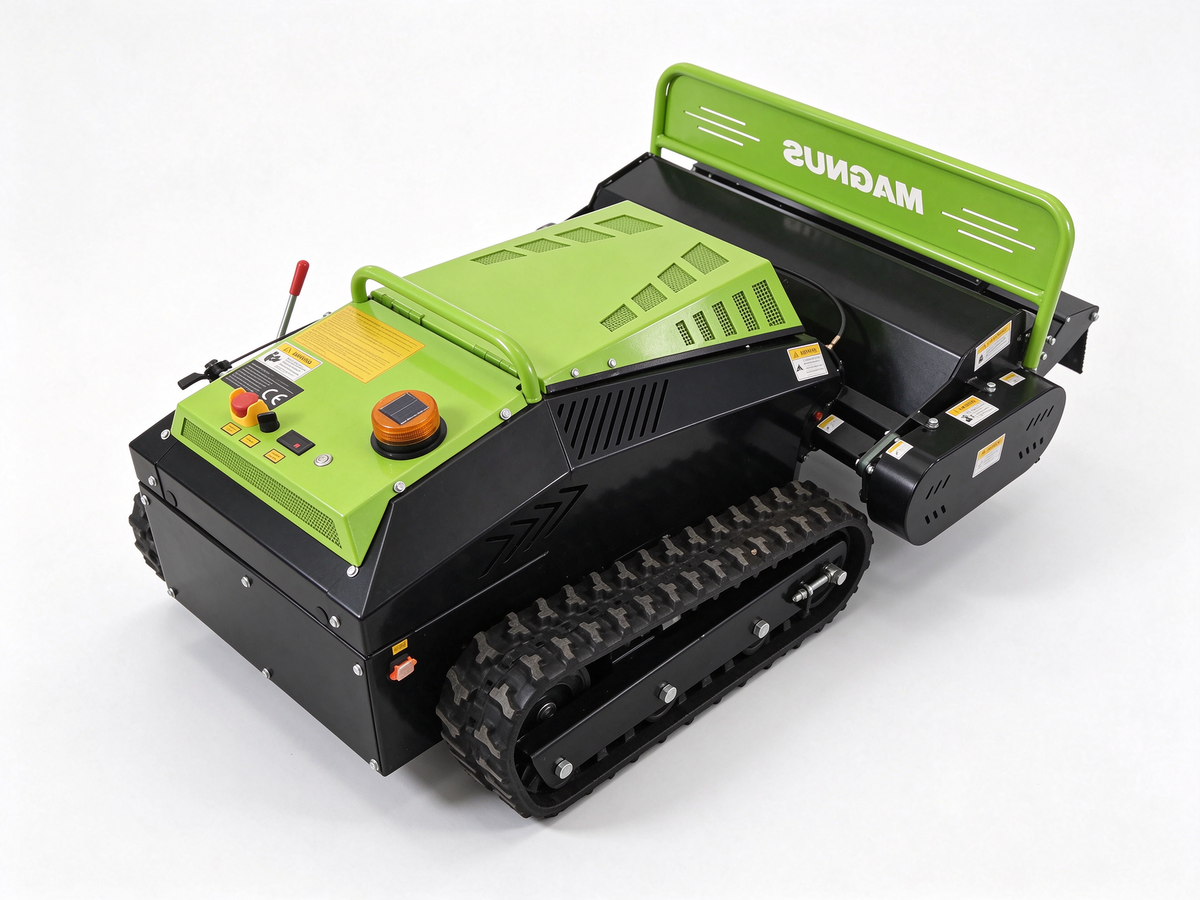
Remote control mower for farms
Farm mowing is not one job. It is row work, headland work, ditch banks and the margins nobody can get a tractor into. The machine that does all four is a compromise; the machine that does two of them well is usually the better purchase.
Four farm jobs, four different failures
A mower that fails in an orchard fails for a different reason than one that fails on a ditch bank. Knowing which failure you are buying against is most of the specification.
Row work in orchards and vineyards. The failure is width. A 1,000 mm deck needs a metre plus clearance on both sides, and it needs a turning space at the end of the row. In a 1.8 m vineyard row a 1,000 mm deck is comfortable; in a 1.2 m row it is not, and no amount of hydraulic lift changes that. This is the job the 500 mm and 800 mm decks exist for.
Pasture topping and headlands. The failure is finish and speed. Topping is a maintenance cut — you want it flat, even and fast, not mulched into windrows. A two-blade deck leaves a lawn finish and needs less power per metre than a 66-blade rotor, which is why the MA-80P and MA-100 use it.
Ditch banks and embankments. The failure is slope and traction. Every model is rated to 45° in all directions on firm, dry ground. Wet clay, loose scree and soft peat are a traction limit rather than an angle limit, and on saturated clay no tracked machine holds 45°. On a ditch bank the honest question is not “what is the rated angle” but “how wet is it in February”.
Margins, fences and scrub. The failure is stem diameter. Standing growth up to 3 m, with stems up to 40 mm across — two separate limits, both of which apply. A 54 or 66 blade rotor shears stems at that size; a two-blade rotary deck batters them and leaves ragged ends that take longer to die back.
Row width to deck width
These are working numbers, not catalogue numbers. They assume a straight row and a competent operator; add clearance for posts, wires and headland turning.
| Row spacing | Deck that fits | Model | Note |
|---|---|---|---|
| Under 1.2 m | 500 mm | MA-50P | 140 kg, 7 hp. The only model that will pass a narrow terrace or a dense vine row |
| 1.2 – 1.8 m | 800 mm | MA-80P or MA-80-1 | Two-blade for finish, 54-blade for growth. Same chassis, different job |
| 1.8 – 2.5 m | 1,000 mm | MA-100 or MA-100-1 | Best output per hour; still leaves room to turn at the row end |
| Open ground, no rows | 1,000 mm | MA-100-2 | 10–300 mm cut height range, for rank growth one week and a finish cut the next |
Every model uses the same 2.4 GHz proportional handset and the same 200–500 m radio link. Compare all seven

Working alone, on ground you would not walk
The point of the remote is not convenience. It is that the operator never has to be on the slope, in the row, or under the tree.
The operator stands on level ground. That is the whole safety case for a tracked remote machine, and it is also the productivity case: you can work a bank in February that you would not walk in July.
The link is proportional, not a switch. A joystick gives proportional drive and steering, so the machine creeps at the edge of a ditch instead of lurching. If the radio link drops, the deck stops.
Range is 200 to 500 m, and it is line of sight. A hedge, a shed or a row of trees cuts it. On a 20 ha block you work from the headland or the access track, not from the far corner.
Servicing is done standing up. Belts, blades, tracks and controllers are standard items, and every part number is in the manual. On a farm the real cost of a machine is the day it spends waiting for a part.
Farm mowing questions
Will a 1,000 mm deck work in a 1.5 m vineyard row?
It will pass, but you will spend the season steering rather than mowing, and the headland turns will cost you more time than the extra width saves. In a 1.5 m row we usually recommend the 800 mm deck. The rule of thumb is that you want at least 300 mm of clearance on each side of the deck at its widest point, and more if the row is not straight.
How steep a bank can it actually work?
45° in any direction, on firm ground that is not wet or soft. That is the rating and we will stand behind it. Traction is what changes, not the machine: wet clay, loose scree and soft peat break the tracks away before the deck reaches its angle limit. If your bank is wet for part of the year, tell us — track pattern and which model carries its weight lower both matter, and that is what the MA-80-SA is for.
What does it do to pasture — mulch or windrow?
Mulch, discharged down and back under the deck. On topping work that is what you want: the cut material returns to the sward instead of lying in rows that have to be raked or harrowed. If you need a windrow for baling, this is the wrong machine and we will say so.
Can it handle rushes and bracken?
It cuts them, and it will not eradicate them. Reed, bracken and rank grass are tall, fibrous and wet at the base — they wrap a spindle and they come back. The method that works is a first pass high to take the standing material down, then a second pass low. On that ground cut-height range matters more than blade count, which is why the 10–300 mm range on the MA-100-2 is worth having.
What is the smallest order you will ship?
One machine. Single units go as LCL or by air freight depending on the destination, and the freight is a larger share of the cost than it is on a container. We quote FOB Qingdao, CIF or DDP, and we will tell you which one is cheaper for your volume rather than defaulting to the one that suits us.
Tell us the row, the slope and the growth.
We will name the deck and the engine, and tell you if the job needs two machines instead of one.