Applications
Four ground types pay for a remote control mower. The rest do not.
The machine is expensive next to a ride-on. It earns that premium only where the ground is steep, narrow, repetitive or dangerous — ideally several at once. Below is what changes in each case, including the model we would quote.
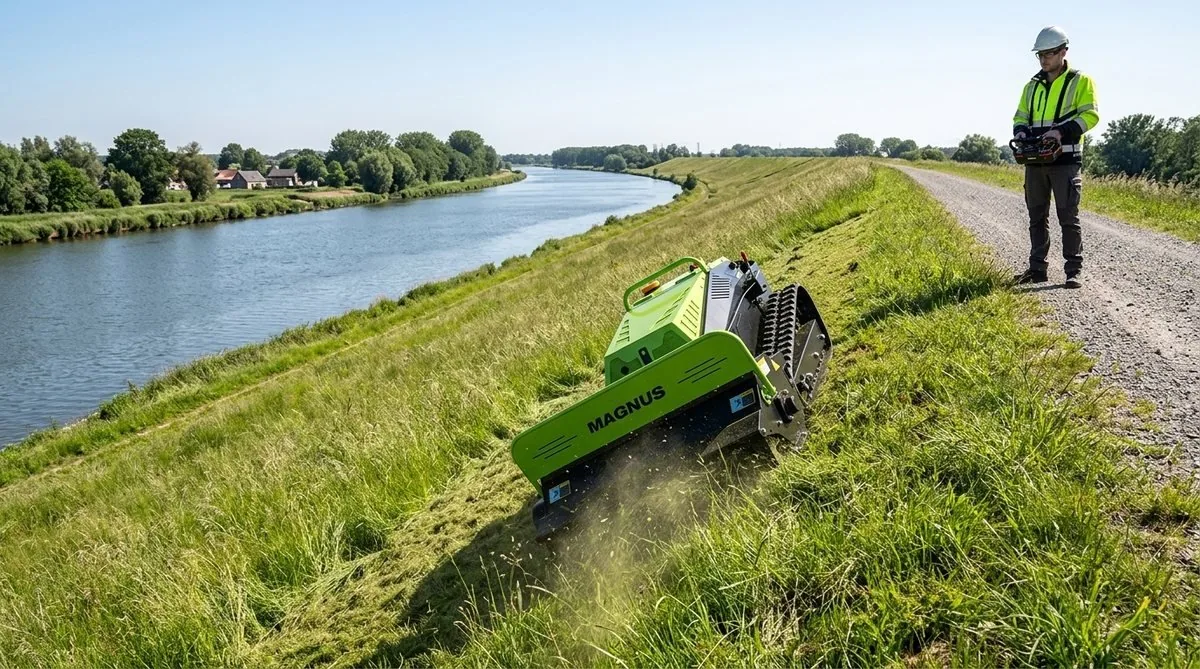
Remote control mowers are bought mainly by landscaping contractors, orchard and vineyard growers, roadside vegetation crews and solar-farm operators. The common factor is ground a ride-on cannot safely cut: sustained grades, access narrower than a tractor, standing brush, or work that puts a person next to traffic.
Steep banks and embankments
River banks, motorway cuttings, dam faces, bunds.
What we quote
- Model
- MA-100-2
- Rotor
- 66 blades
- Cut height
- 10–15 cm
- Pattern
- Traverse, top down
The economic argument is simple. A three-person strimmer crew on a 25° bank loses most of its output to footing, rope work and repositioning; the same face takes one operator and a tracked mower a fraction of the time, with nobody on the incline at all.
The second gain is safety liability. On a river bank or a cutting, the risk of a fall is the reason the job is expensive to insure. Moving the operator to the crest removes that exposure rather than managing it with harnesses.
What to watch
- Surface, not angle. Wet clay and loose gravel are where traction goes; see the derating table.
- Access to the crest. The operator needs to walk the top of the bank with the transmitter. If that is fenced or planted, plan a different access.
- Material. Long grass on a bank hides debris. Walk it before the first pass.
Orchards and vineyards
Row middles from 90 cm, under-canopy work, terraces.
What we quote
- Model
- MA-50P / MA-80P
- Rotor
- 2 blade
- Cut height
- 6–10 cm
- Row width
- from 90 cm
Row middles in mature orchards are typically 0.9–1.5 m. The MA-50P passes with the deck centred, which matters because a deck that has to run offset drifts into trunks on the return pass. The MA-80P covers the wider rows and gives a cleaner finish.
Two operational details decide whether growers keep using the machine. First, cut height: set it above the graft union and above any drip line lying on the ground. Second, timing: mow before fruit drop, not after, so fallen fruit is not thrown by the rotor.
Hillside vineyards
Terraced vineyards are where the SA models earn their price. The adaptive deck follows the terrace instead of holding a fixed height, so it scalps less where the ground rolls. Work each terrace as a single traverse, starting at the top, with the operator on the terrace above.
Roadside and right-of-way
Verges, medians, embankments beside live traffic.
What we quote
- Model
- MA-100-1
- Rotor
- 66 blades
- Cut height
- 10–20 cm
- Duty
- Sustained
Highway authorities and their contractors hit the same problem on every job: the verge is steep and the operator is exposed to live traffic. A remote mower moves the operator behind the barrier or up the bank, which is often the difference between a job that needs a lane closure and one that does not.
Width drives cost here. A 1,000 mm rotor cuts a verge in fewer passes than an 800 mm machine, and pass count is the line item that decides whether the contract is profitable.
Practical constraints
- Discharge side. The rotor throws material. Keep the discharge away from traffic and use the deflector.
- Visibility. Retro-reflective panels and a beacon are dealer-fit options in most jurisdictions.
- Debris. Roadside verges collect litter and tyre fragments. Inspect before the first pass of the season.
Solar farms and industrial land
Panel rows, substation compounds, vacant lots.
What we quote
- Model
- MA-100-2
- Rotor
- 66 blades
- Cut height
- 8–10 cm
- Pattern
- Rows, 2 passes
Between panel rows the clearance is usually 1.2–2.0 m and the ground is graded to a consistent fall. That is ideal territory: the same pass repeats for hectares, so one operator holds a rhythm and covers ground quickly.
Fleet buyers care about two things beyond cut quality: whether the machines share parts, and how long a seasonal operator takes to become productive. On the MAGNUS range, blades, filters and belts are common across models, and a new operator is consistent within about a week.
Fleet considerations
- Shared consumables. One parts bin covers a mixed fleet of P, standard and SA models.
- Training. Half a day to be safe, a week to be productive.
- Logistics. Sea or rail freight; each machine ships in one export crate.
Fit at a glance
If your job sits in the left column, the machine will earn its keep. If it sits in the right, buy something else.
| Good fit | Poor fit |
|---|---|
| Banks and embankments with no safe footing | Flat lawns above 1 ha |
| Rows and gaps from 0.9 m wide | Finish cut on ornamental turf |
| Standing brush up to 3 m | Single one-off clearance jobs |
| Operator exposure to traffic or height | Ground with buried irrigation or cable |
| Repeated verges or panel rows | Mature timber above 30 mm stems |
Tell us what you need to cut.
Share your terrain, area and vegetation type. We come back with a model recommendation and a landed price.