How it works
How a remote control lawn mower works
Four subsystems do the work: a radio link that carries commands, a motor drive that turns them into track motion, a rotor that converts engine power into mulch, and a lift system that sets the cut height.
MAGNUS engineering
Published 19 Feb 2026
Updated 6 Oct 2026
6 min read
A remote control mower removes the operator from the machine but not from the decision loop. Every steering input and every throttle change is still a human judgement — transmitted rather than applied through a seat and a pair of hands.
1. The radio link
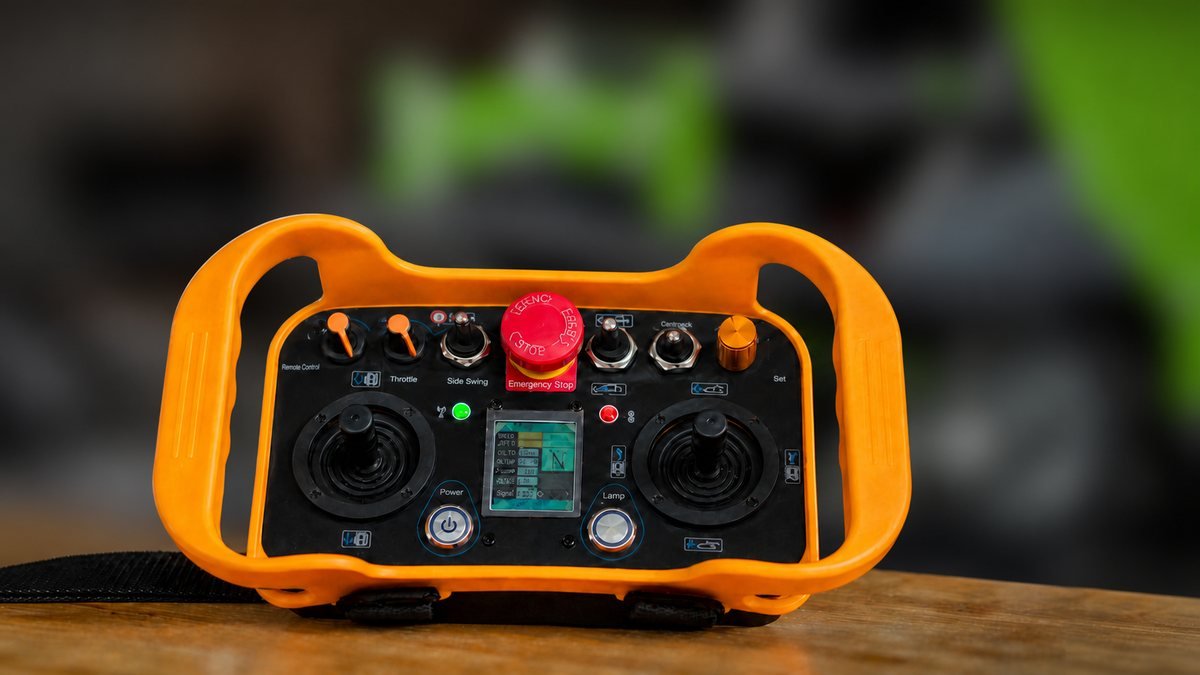
The transmitter sends a packet many times per second on the 2.4 GHz band. Two design details separate a usable link from a dangerous one.
- Failsafe on loss of signal. If valid packets stop arriving, the receiver disengages the rotor drive and applies the track brakes. The machine stops where it is rather than continuing on the last command.
- Proportional control, not switches. Track speed follows stick position continuously. Bang-bang control makes a machine lurch on a slope, which is exactly where smoothness matters.
Range is quoted at 200–500 m line of sight. Treat that as a ceiling in open air: a hedge, a ridge or a steel-clad building will cut it, and the practical rule is to keep visual contact at all times.
2. Track drive
Each track is driven independently, so steering is skid steer: one track runs faster than the other, or in the opposite direction for a zero-radius turn. There is no steering axle and no differential.
Rubber tracks rather than wheels, for three reasons:
- Contact area. A wide belt on a long footprint spreads the machine’s mass far better than a turf tyre, which keeps ground pressure low enough to avoid rutting a lawn.
- Grip on grass. Lugged rubber keys into the grass mat, which is the difference between climbing a damp bank and sliding down it.
- Load distribution on slopes. A long track keeps the centre of gravity inside the contact patch as the machine pitches, which is the whole basis of slope capability.
3. The spade rotor
The rotor is a horizontal shaft carrying 54 or 66 free-swinging blades inside a fabricated steel housing. Three parameters determine what it can cut.
Blade count. More blades means more impacts per metre travelled, which is why the 66-blade 1,000 mm rotor handles denser material than the 54-blade 800 mm unit at the same forward speed.
Free-swinging mounting. Each blade pivots. Hit a stump and it folds back instead of transferring the shock into the shaft bearing — the same principle as a flail mower, and the reason a rotor survives ground that destroys a fixed blade bar.
Housing clearance. The gap between rotor and housing controls how fine the discharge is. Tight clearance mulches more thoroughly and costs more power; the production setting balances the two for material up to 3 m tall.
4. Lift and cut height
Cut height is set by one of three mechanisms, and this is where the model families differ.
- Hydraulic (MA-80, MA-100-1, MA-100-2): a hydraulic cylinder raises the deck, giving 2–25 cm of range and the ability to lift the head over an obstruction from the transmitter.
- Adaptive (MA-80-SA, MA-100-SA): the deck floats on the ground contour within a 2–20 cm range, trading absolute height control for less scalping on undulating ground.
- Electric actuator (MA-50P, MA-80P): a linear actuator sets 3–13 cm, which is the right range for maintained grass and the lightest of the three systems.
Command chain in a tracked remote mower. The controller splits stick input into independent left and right motor commands; loss of signal drives both the rotor clutch and the brake to a safe state.
5. Reading the numbers on a spec sheet
- Grade in degrees
- tan(θ) × 100 = % grade
- Theoretical output
- deck width × speed
- Real output
- theoretical × 0.75–0.85
- Ground pressure
- mass ÷ track contact area
- Runtime per tank
- tank ÷ (load × consumption)
The figure most often misread is output. A 1,000 mm deck at 4 km/h is about 4,000 m² per hour in theory — roughly one acre. Real output lands at 0.7–0.8 acres once turns, overlaps and the slow sections are counted. Plan labour against the real figure, not the theoretical one.
6. Service schedule
| Interval | Task | Time |
|---|---|---|
| Daily | Clear the deck, check track tension, inspect blades for cracks | 10 min |
| 50 h | Engine oil, air filter, grease rotor bearings and linkage | 45 min |
| 100 h | Hydraulic filter (where fitted), blade balance, track lug wear | 90 min |
| 200 h | Hydraulic oil, shaft bearings, radio range test | 3 h |
| Seasonal | Strip and inspect the deck, touch up paint, test transmitter battery capacity | 1 day |
Blades are the item that quietly costs money. A dull or chipped set raises fuel consumption and leaves a torn finish that browns at the tip. Most contractors keep a spare set and swap rather than sharpen on site.
In one paragraph: a handheld transmitter streams proportional commands over 2.4 GHz; a receiver passes them to a controller that mixes left and right track speeds; independent drive motors turn lugged rubber tracks in skid steer; a 54–66 blade rotor cuts ahead of the tracks, and a hydraulic or adaptive lift sets the height. Loss of signal stops the machine.
Tell us what you need to cut.
Share your terrain, area and vegetation type. We come back with a model recommendation and a landed price.