Slope capability
A slope mower is judged by the ground it holds, not the engine it carries
Two things keep a tracked mower on a bank: where its centre of gravity sits, and how much rubber is in contact with the grass. Everything else — horsepower, deck width, price — is secondary once the ground tilts.
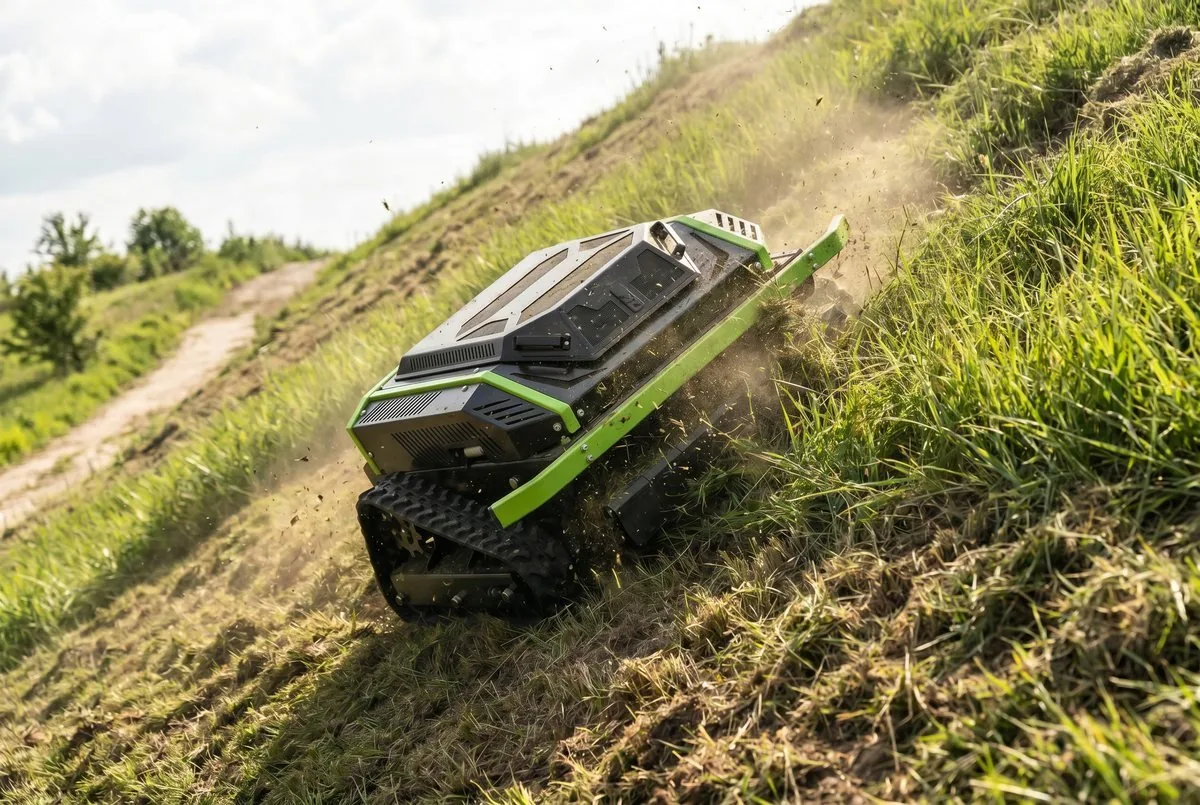
A remote control slope mower is a tracked machine with no seat, a low-mounted deck and a centre of gravity close to the ground, steered by radio so nobody rides on the incline. Stability comes from the track contact patch and deck position; the practical limit is usually traction on wet or loose ground, not the angle itself.
Three design decisions explain why a tracked remote mower holds ground that stops a ride-on. The track footprint is long and narrow, so the centre of gravity has room to move before it leaves the base. The deck hangs ahead of and below the chassis, which drops the combined centre of gravity by a meaningful margin. And nobody is sitting on it — the single largest risk in slope mowing is the operator being ejected or crushed, and that risk is removed rather than managed.
Grade, in plain terms
- 10°
- 17% grade
- 20°
- 36% grade
- 30°
- 58% grade
- 40°
- 84% grade
A typical zero-turn manual limits operation to about 15°. Highway verges and river banks usually sit between 15° and 30°.
Why traction fails before stability does
Buyers assume a machine tips at its rating. In practice the tracks lose grip first. The drawing below shows the geometry that keeps a tracked mower stable well past the point where it stops climbing.
Geometry drawn to scale at 40°. On the incline the plumb line falls inside the track patch but closer to the downhill edge, so the margin shrinks as the angle rises. Whether a given model is rated for a specific face depends on its track width, deck mass and the surface — we confirm that per site rather than publishing one headline number.
What actually stops a job
In the order these turn up on real sites.
1. Track slip on wet or loose ground
Grass holds a lugged rubber track well. Wet clay, gravel and dry thatch do not. Slip shows up as the machine drifting sideways on a traverse — when that starts, stop and work the face from a different angle, or wait for the ground to dry.
2. Material jammed under the deck
A branch caught between rotor and deck lifts the front of the machine and unloads the tracks. Walk the slope before the first pass. The free-swinging blades fold on impact rather than transferring the hit into the shaft, but they cannot clear a log.
3. Radio shadow
A bank plus a hedge line can put the machine out of sight from the base. Keep the operator high and to the side, and reposition before the machine drops behind the crest.
4. Operator fatigue
Four hours of watching a machine on a steep face is tiring in a way that surprises first-time buyers. Most contractors rotate operators at the two-hour mark on sustained slope work.
Derating by surface
Start from the model’s dry-grass capability, then subtract for the surface. This is how we size a machine for a site we have only seen in photographs.
| Surface condition | Adjustment | Note |
|---|---|---|
| Dry, short grass | 0° | Reference condition |
| Dry, long grass over 250 mm | −3° | Cut in two passes at different heights |
| Damp grass, no standing water | −6° | Most morning dew falls here |
| Wet clay or bare soil | −10° | Traverse only, never climb |
| Loose gravel or scree | −12° | Tracks cannot key into the surface |
| Frozen or snow-covered | Do not operate | Traction unpredictable, rotor impact risk |
These adjustments are our field guidance, not a substitute for a site assessment. Send photographs and the measured angle and we will confirm the model and the pass pattern in writing.
Which model for which bank
Slope work narrows the range quickly.
WIDEST CUT
MA-100-2
1,000 mm, 66 blades, 16 hp, 170×118×75 cm. The default for long embankments where pass count drives cost. Heaviest of the range, so plan trailer capacity.
UNEVEN GROUND
MA-100-SA
Same width with an adaptive deck that follows the contour. Better on terraces and undulating pasture where a fixed deck would scalp.
TIGHT ACCESS
MA-80 / MA-80-SA
800 mm deck on a 163–166 cm chassis. Where the bank is reached through a gate or a narrow track, this is the practical choice.
Slope mower questions
Yes — it is the main reason buyers choose one. The machine is tracked, carries its deck low and ahead of the chassis, and has nobody on board. The working angle depends on model and surface, and we confirm it per site before quoting.
Sliding. Rubber lugs rely on friction with the grass mat, and that falls sharply on wet clay, loose gravel or dry thatch. You will see the machine drift sideways long before it becomes unstable.
Across, in overlapping passes, starting from the top. Traversing keeps both tracks loaded and the deck level. Climbing straight up unloads the uphill track; descending straight down risks running into the finished cut.
A shallow V-ditch, yes, if both faces stay within the derated angle and the machine can be driven out under power. Steep-sided channels need a flail head on an articulated arm, which is a different machine class.
Tell us what you need to cut.
Share your terrain, area and vegetation type. We come back with a model recommendation and a landed price.