Petrol, diesel or battery for a remote control mower
Petrol, diesel or battery for a remote control mower
Petrol dominates this category for a reason. Where diesel earns its cost, why battery is not there yet, and the questions that decide it.
Almost every remote control mower sold today runs on petrol. That is not because petrol is better in every case. It is because the power-to-weight ratio works out, the engines are cheap and available anywhere, and nobody has yet built a battery machine at this size that an operator will pay for.
We get asked about diesel and battery regularly. Here is an honest comparison, including where each option loses.
Why petrol dominates this category
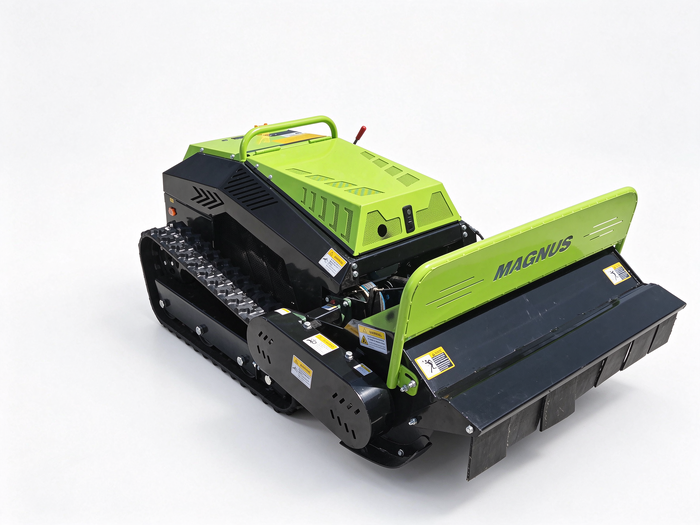
A 1,000 mm tracked mower weighs around 360 kg and needs 16 hp to cut heavy growth without stalling. A Loncin 459 cc petrol engine delivers that from about 30 kg of metal. The same power from a diesel engine means more weight, more cost and a bigger frame.
There is also the service question. Loncin engines are copies of well known Honda patterns, parts are everywhere, and any small engine mechanic can work on one. That matters when the machine is on a site in Chile and the nearest dealer is four hours away.
The trade-off is fuel handling. Petrol goes stale, it is dangerous to store, and it cannot be left in the tank over winter without treatment.
When diesel makes sense
Diesel earns its place when the machine runs hard for long hours. Two cases come up.
The first is continuous heavy cutting, where the engine sits at high load for most of the day. Diesel handles that without the heat and fuel consumption penalty that a small petrol engine shows at sustained load.
The second is fleet operation, where one machine might do 1,500 hours a year. At that utilisation the longer service life and lower fuel cost per hour start to offset the higher purchase price.
Below about 800 hours a year, we struggle to make the numbers work for diesel. The machine costs more, weighs more, and needs a different level of workshop support.
| Petrol | Diesel | Battery | |
|---|---|---|---|
| Power-to-weight | Good | Poor | Poor at this size |
| Purchase cost | Lowest | Highest | High |
| Fuel cost per hour | Moderate | Lowest | Lowest, if electricity is cheap |
| Service network | Anywhere | Specialist | Limited |
| Noise and exhaust | Loud, fumes | Loud, more fumes | Quiet, no exhaust |
| Cold start | Easy | Hard | Reduced range in cold |
| Refuelling | Jerry can | Jerry can or bowser | Charger and mains supply |
The battery question
Battery machines exist in this category and they are getting better. We do not sell one, and the reason is not that we are attached to petrol.
Cutting heavy growth takes a lot of energy. A machine that runs all day on petrol needs either a very large battery or a swap system, and both add weight and cost. Then there is charging: many of the sites where these mowers work have no power at all. A solar farm might, an embankment in the middle of nowhere will not.
Where battery does make sense is confined or noise-sensitive work. Municipal sites near housing, indoor or semi-indoor applications, and anywhere the exhaust is the problem rather than the cutting. If that describes your site, a battery machine from a specialist supplier is worth looking at, and we will say so rather than sell you a petrol unit you will regret.
What actually decides it for most buyers
In our experience the choice comes down to three practical questions, and none of them are about engine technology.
How many hours a year will the machine run? Under 800, petrol. Well over 1,000 with heavy load, look at diesel.
Who services it? If the answer is “the local small engine shop”, petrol. If you have a workshop with diesel experience, the diesel option opens up.
Where does it refuel? A machine that needs a bowser and a fuel store is a different proposition from one that takes a jerry can.
A note on fuel storage
Petrol with ethanol in it degrades in storage. If your machine sits for weeks between jobs, either run the tank dry, use an ethanol-free fuel, or add stabiliser. We have seen more carburettor problems caused by stale fuel than by any mechanical fault.
Store fuel away from the machine, in a proper container, and never refuel a hot engine. That last point sounds obvious until you watch someone do it.
Questions buyers ask us
Can I convert a petrol mower to diesel later?
Not practically. The engine mounting, hydraulic pump coupling and frame are designed around one power unit. A conversion costs more than buying the right machine.
Is a bigger engine always better?
No. A 16 hp engine on a 500 mm deck is wasted, and a 7 hp engine on a 1,000 mm deck in heavy brush will stall constantly. Engine size should follow deck width and the vegetation you actually cut.
What about propane?
It comes up occasionally for indoor or emission-sensitive work. Availability of refills is the limiting factor in most export markets, so we do not offer it as standard.
Tell us your hours and we will tell you the engine
Send us the annual hours, the vegetation and where the machine will be serviced. We will recommend a configuration and say plainly if petrol is the wrong answer for your site.
Related guides
Read next
Tracked mower track tension: how to read the wear
How to check tracked mower track tension by hand, what a slack track sounds like, and the wear pattern that…
When to sharpen remote control mower blades
How to tell a dull blade from a damaged one, the three signs a remote control mower blade is past…
Tracked or wheeled: which mower actually holds a slope
Tracks and wheels fail in different ways. What a wheel does on a bank, what a track does instead, and…
Send the slope. We will confirm the model.
Tell us the gradient, the area and the nearest port. We reply with a model and a landed cost within one business day.