What a Remote Control Mower Costs Over Three Years
What a Remote Control Mower Costs Over Three Years
Purchase price is only half the cost. A three-year breakdown of cutting parts, fuel, service, downtime and transport for a remote control mower.
The purchase price of a remote control mower is the smallest part of what it costs you. Across a three-year ownership cycle, the machine itself typically accounts for 45–60% of the total; blades, fuel, service, downtime and transport make up the rest.
This article breaks down where the money actually goes, with the assumptions stated plainly so you can substitute your own numbers. It is written for buyers comparing a remote control mower against contract labour, and for dealers who need to defend the price in a competitive tender.
The five cost lines
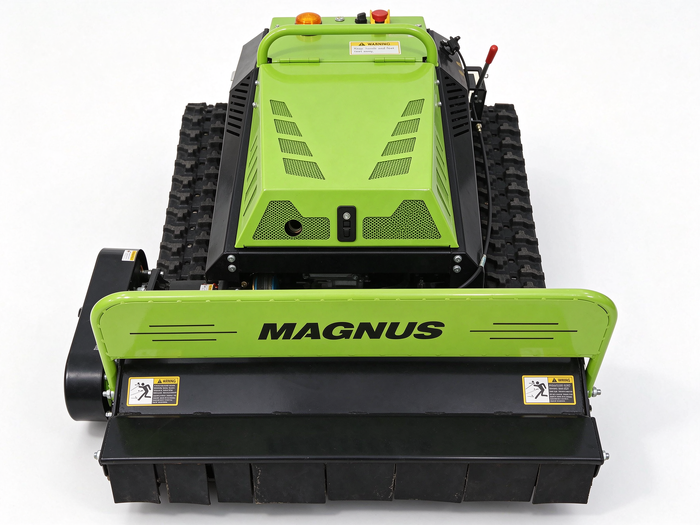
1. Cutting parts
This is the line buyers most often underestimate. Blades and rotors are consumables, and consumption depends almost entirely on what you cut rather than how much area you cover.
| What you cut | Expected blade life | Notes |
|---|---|---|
| Maintained grass | Long | Sharpening extends life considerably |
| Rough pasture | Moderate | Occasional sharpening, occasional replacement |
| Brush and saplings | Short | Impact damage, not wear, drives replacement |
| Ground with stones or debris | Very short | Inspect before every session |
A spade rotor with 54–66 individual blades is more expensive to maintain than a two-blade deck, but it also survives material that would destroy a two-blade deck in a single pass. The comparison only makes sense against the vegetation you actually have.
2. Fuel
Petrol engines in this class run at roughly 1.5–3 litres per hour depending on load. Brush cutting under load sits at the top of that range; light grass sits at the bottom.
Fuel cost is directly tied to how you operate. Running a 1,000 mm deck on light grass burns more than running an 800 mm deck, because you are moving more steel and more air for no gain in output. Matching deck width to vegetation is a fuel decision as much as a cutting decision.
3. Scheduled service
Engine oil, air filter, hydraulic oil and hydraulic filter on a fixed interval. For a machine doing 500 hours a year, budget for two to three services annually. This is predictable and small compared with cutting parts.
What is not predictable is hydraulic failure caused by neglected oil. A hydraulic pump replacement costs more than a decade of oil changes. This is the single most common false economy in the category.
4. Downtime
Downtime is the cost that never appears in a spreadsheet and always appears in the P&L. If a machine is down during the cutting window, the work either gets done by contract labour at short notice or does not get done at all.
Two things reduce it: spare parts held locally, and a machine whose consumables are standard rather than proprietary. Ask any supplier two questions before you buy: how fast can you ship a blade set, and what is the lead time on a hydraulic pump.
5. Transport
Tracked machines need a trailer and a ramp. If you move between sites daily, loading time is a real cost: fifteen minutes each way, twice a day, is 125 hours a year.
For buyers with many small sites, this line can exceed the fuel cost. For buyers with one large site, it is close to zero.
A worked example
Assumptions, stated so you can adjust them: one machine, 600 operating hours per year, mixed rough grass and light brush, one operator, three-year horizon. Figures are indicative and exclude the purchase price.
| Cost line | Year 1 | Year 2 | Year 3 |
|---|---|---|---|
| Cutting parts | Baseline | Baseline | Baseline + rotor service |
| Fuel | Baseline | Baseline | Baseline |
| Scheduled service | 2 services | 3 services | 3 services |
| Unplanned repair | Low | Low | Rises (hoses, bearings) |
| Transport | Site dependent | Site dependent | Site dependent |
The pattern that matters: years one and two are cheap and predictable, year three is where wear items start to cluster. Buyers who budget only for the purchase and the first year are consistently surprised by year three.
What changes the maths most
Vegetation, not area. A hectare of brush costs several times more to maintain than a hectare of pasture. Suppliers who quote cost per hectare without asking what is growing on it are guessing.
Hours per year. A machine doing 200 hours a year will reach year five with fewer problems than one doing 1,000 hours a year reaches in year two. Service intervals are in hours, not months.
Operator discipline. Checking blades before each session and stopping when you hit stone is free. Replacing a bent rotor shaft is not.
Slope. Working on gradient loads the engine and the hydraulic system harder than flat work, and it slows travel. Budget for higher fuel consumption per hectare on steep ground.
Where buyers overspend
- Buying deck width they cannot use. A 1,000 mm deck on a site with narrow gates and tight access spends its life being manoeuvred rather than cutting.
- Buying for the best case. Specifying for average ground rather than the worst section means the hard part still gets contracted out.
- Skipping the spare parts order. The first blade set bought with the machine costs less than the emergency shipment bought later.
- Ignoring the transport line. A machine that is right for the job but wrong for the trailer becomes a fixed asset that stays on one site.
Frequently asked questions
How much does a remote control mower cost?
Tracked machines in this class typically land between roughly USD 2,000 and 6,000 FOB depending on deck width, engine and rotor type, with freight and duty on top. The exact figure depends on specification and destination. Send us your slope, area and port and we will quote a landed price rather than a range.
What is the maintenance cost per year?
For a machine doing 500–600 hours a year on mixed grass and light brush, consumables and scheduled service are a small fraction of the purchase price annually. The variable is cutting parts, which is driven by what you cut, not by area.
Is a remote control mower cheaper than contract labour?
On steep or awkward ground, usually yes within two to three seasons, because contract crews charge a premium for the same difficulty and you pay that premium every year. On flat, accessible grass the comparison is much closer and depends on your hourly rate.
Ask for a costed configuration
Send us the area, the vegetation, the gradient and your destination port. We will recommend a model, list the consumables it will need in the first two years, and quote a landed price, so you can compare total cost rather than sticker price.
Related guides
Read next
Tracked mower track tension: how to read the wear
How to check tracked mower track tension by hand, what a slack track sounds like, and the wear pattern that…
When to sharpen remote control mower blades
How to tell a dull blade from a damaged one, the three signs a remote control mower blade is past…
Tracked or wheeled: which mower actually holds a slope
Tracks and wheels fail in different ways. What a wheel does on a bank, what a track does instead, and…
Send the slope. We will confirm the model.
Tell us the gradient, the area and the nearest port. We reply with a model and a landed cost within one business day.