Estates, parks, campuses, business parks
Remote control mower for grounds maintenance
On maintained ground the machine is judged twelve times a year, not once. That changes the question from “what can it cut” to “what does it cost to run, and does the finish still look right in October”.
Four kinds of maintained ground
Grounds work is defined by who is standing on the grass while you cut it, and by how often you come back.
Private estates and large gardens. Mixed ground: a lawn in front of the house, rough grass behind it, a bank down to the water, and a paddock that is cut twice a year. One machine rarely does all four well, and the usual answer is a finish deck plus a flail deck on the same chassis family.
Parks and public open space. The constraint is the public. A machine that throws material sideways is a machine that generates complaints and, eventually, a claim. A flail deck discharges down and back under the machine, and the operator stands away from the deck rather than behind it.
Campuses, business parks and hospitals. Timing matters as much as finish. Cutting at 7 am beside a ward or a call centre is a decision someone will hear about. Remote operation lets the operator work a bank or a verge at a distance, but it does not make the machine quiet — petrol engines are petrol engines, and we will give you the noise figures rather than a promise.
Golf rough, sports ground margins and amenity grassland. The constraint is consistency. Rough that is cut at the same height on the same schedule plays the same way every week; rough cut when someone has time does not. A deck with a hydraulic lift and a repeatable height setting is worth more here than a wider deck.
Finish or rough cut: pick one per deck
This is the decision that determines what the ground looks like in October, and it is made before the model, not after.
| Deck | Cut quality | Best on | Models | Trade-off |
|---|---|---|---|---|
| Two-blade rotary | Lawn finish, clean stripes | Lawns, amenity grass, pasture topping | MA-50P, MA-80P | Batters woody growth instead of shearing it; ragged ends on bramble |
| 54-blade flail | Even mulch, no windrow | Rough grass, banks, verges, light scrub | MA-80-1, MA-80-SA | Needs more power per metre than a two-blade deck |
| 66-blade flail | Fine mulch, widest cut | Large areas, heavy growth, mixed ground | MA-100, MA-100-1, MA-100-2 | Heaviest machines; check the ground will take the weight |
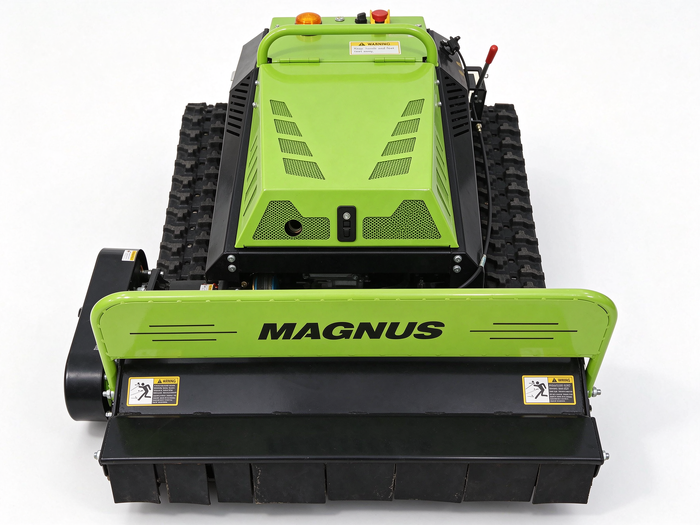
Same chassis, different job. Flail vs rotary, compared properly

What it costs to run, honestly
We are not going to quote a cost per hectare, because it depends on your ground, your operator and your fuel price. What we can tell you is what drives it.
Blade count sets the power draw. Sixty-six blades passing a counter-blade continuously is a much higher load than two blades sweeping through grass. On light growth a two-blade deck uses less fuel per hectare; on heavy growth it takes a second pass, which costs more than the fuel saved.
Width sets the hours. A 1,000 mm deck at 3 km/h covers about 3,000 m² per hour in theory and roughly half that in real conditions. Doubling the width does not halve the time if the ground is broken, but on open amenity grass it comes close.
Blades are consumables, and they are individually mounted. A stone costs one blade, not a rotor. On stony ground that is the maintenance budget, and it is the reason the mounts are designed the way they are.
Weight sets the wear on turf. A 360 kg machine turns harder than a 140 kg one. On soft ground in winter, the lighter machine finishes the job and the heavier one leaves ruts that cost more to repair than the mowing saved.
Grounds maintenance questions
Will a flail deck leave a lawn-quality finish?
No, and anyone who says otherwise is selling you the wrong deck. A flail mulches: it cuts the growth into smaller pieces and leaves them on the surface. That reads as an even sward from a distance and as mulch up close. If the ground in front of the house has to look like a lawn, that is a two-blade deck — the MA-80P on an 800 mm cut, or the MA-100 on 1,000 mm.
How loud is it, and can it work near buildings?
It is a petrol engine — 224 to 459 cc — so it is not quiet, and we will send you the measured noise figure rather than describe it. What remote operation changes is where the operator stands, not how much noise the machine makes. If you are cutting beside a ward, a school or an office, the practical answer is timing rather than a quieter machine.
Can it mow a bank beside water?
It can work the bank. It is not designed to enter water, and the rated 45° applies to firm, dry ground — a soft, wet bank beside a pond is a traction problem well before it is an angle problem. Keep the machine above the waterline, work across the face rather than up and down it, and treat the bank edge as the limit.
What area justifies a 1,000 mm deck?
As a rough guide, above about four hectares of open, maintained ground the wider deck pays for itself in hours saved. Below that, and especially where there are beds, trees and tight corners, the 800 mm deck is usually faster overall because it spends less time manoeuvring. The honest test is how much of your ground is open run and how much is obstacle.
Do you supply machines for a grounds contractor’s fleet?
Yes, and that is a different conversation from a single estate. Fleet buyers usually want one chassis family across several decks, a shared spare parts kit, and OEM colours if the fleet is branded. The dealer programme covers the commercial terms; the engineering is the same machines.
Send the site plan. We will name the deck.
Area, slope, what is planted on it, and how often you cut. That is enough.