Road shoulders, embankments, drainage channels
Remote control mower for verges and embankments
A verge is the one mowing job where the grass is not the hazard. The traffic is, the angle is, and the fact that nobody can stand next to the machine is. That combination is why this work moved to tracked remote machines before any other.
Why a verge is not a field
Four things change the moment the ground is beside a carriageway rather than inside a fence.
The operator cannot stand next to the machine. On a live carriageway there is no safe place to walk behind a mower. A remote machine puts the operator on the verge top, behind the barrier, or in the lay-by — anywhere but in the lane.
The angle is not optional. Embankments are built at an angle precisely because they are not meant to be walked. Every model is rated to 45° in all directions on firm, dry ground. Wet clay, loose scree and soft peat are a traction limit rather than an angle limit, and on saturated clay no tracked machine holds 45°.
Discharge direction is a safety specification. A rotary deck throws material out of the deck edge, sideways, several metres, in the direction of travel. Beside a carriageway that is a hazard to traffic; beside a footpath it is a complaint. A flail deck holds the material in the housing and discharges it down and back under the machine.
The job is inspected, not just done. Council and contractor work is judged on sight lines and finish at handback, not on hectares per hour. That favours a deck that leaves an even sward over one that covers ground fastest.
The safety case, in the order a risk assessment asks for it
We do not write your risk assessment. We supply the machine documentation it needs, and we tell you plainly what the machine does and does not do.
| Hazard | What the machine changes | What it does not change |
|---|---|---|
| Operator in the carriageway | Operator works from the verge top or behind the barrier, up to 500 m away | Traffic management is still yours; the machine is not a lane closure |
| Ejected material | Flail deck discharges down and back under the machine | Debris can still leave the deck edge sideways. Keep the working distance |
| Overturn on a bank | Tracked chassis, low centre of gravity, 45° rated on firm dry ground | Wet clay and soft peat reduce traction well below the rated angle |
| Contact with blades | Blades stop when the radio link drops; deck is serviced from outside the housing | Isolate before any maintenance. The manual states the procedure |
| Pedestrians and cyclists | Nobody walks behind the machine | Shared paths still need signing and timing. That is a site decision |
Every unit ships with CE declaration, operating manual, and noise and vibration figures. Ask for the document pack
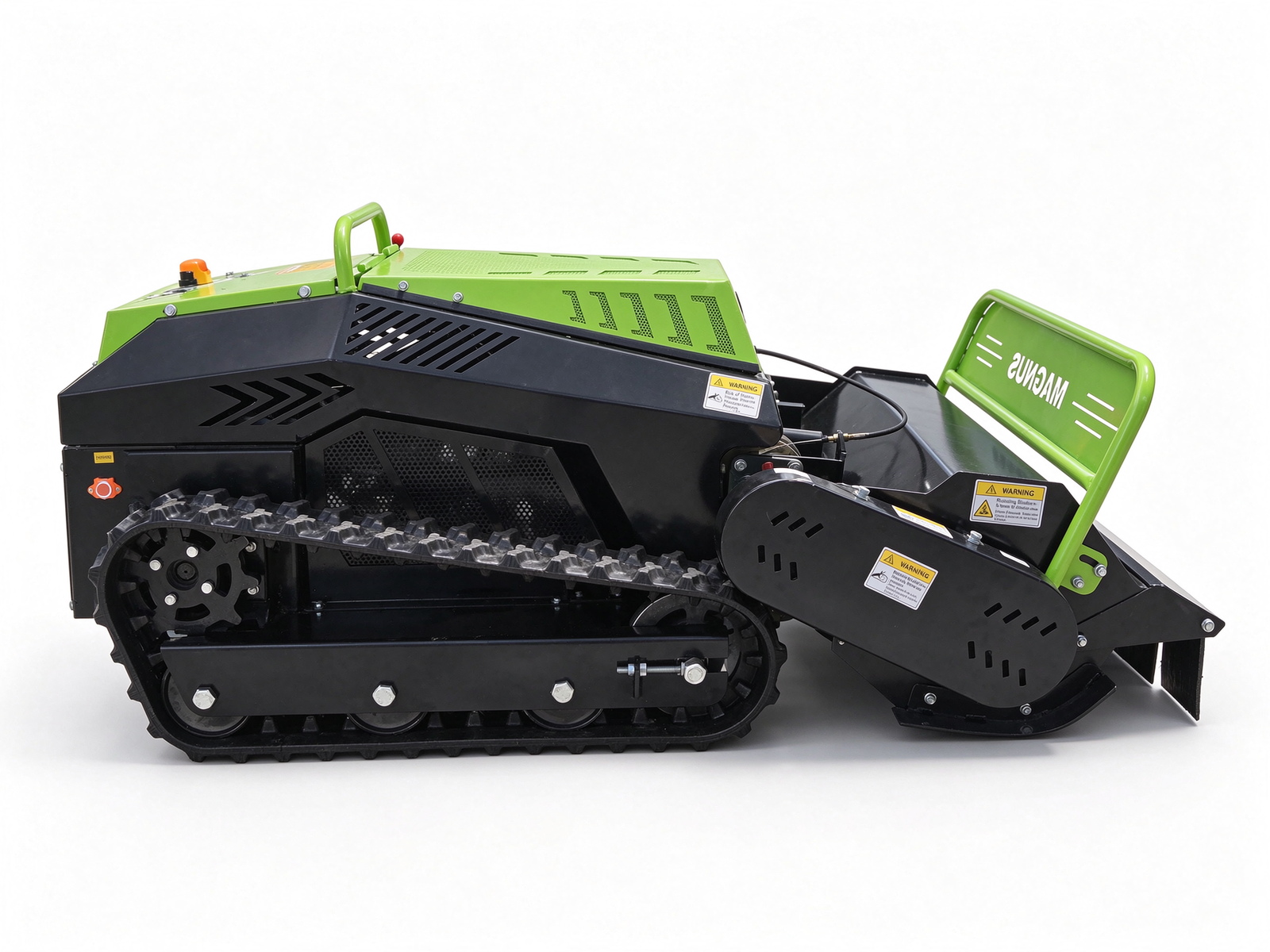

Which deck for which verge
Verge work splits by how the ground is shaped, not by how much of it there is.
| Verge type | Constraint | Model | Why that one |
|---|---|---|---|
| Flat shoulder, wide | Output per shift | MA-100 | 1,000 mm 66-blade rotor, 16 hp. Fastest finish on open shoulder |
| Steep embankment | Angle and traction | MA-80-SA | Lowest centre of gravity in the range, 459 cc, wide track stance |
| Narrow verge, barrier behind | Width | MA-50P or MA-80P | 500 and 800 mm decks work where a 1,000 mm deck will not fit |
| Ditch bank and channel | Slope, silt, wet base | MA-80-1 or MA-100-1 | 54 and 66 blade rotors, 20–250 mm range for a two-pass method |
| Heavy growth, seasonal cut | Stem diameter | MA-100-2 | 10–300 mm cut range, for rank summer growth and a low cut in autumn |
Standing growth up to 3 m, stems up to 40 mm. Two separate limits, both apply. Full specifications
Verge and embankment questions
Can it work a 45° embankment in wet weather?
The 45° rating is a firm, dry ground figure and it applies in all directions. Wet clay is a traction limit rather than an angle limit, and no tracked machine keeps its grip on saturated clay at that angle. If your embankments are wet for part of the year, say so at quotation stage — track pattern and where the machine carries its weight both matter, and that is what the MA-80-SA is for.
Does it throw stones at traffic?
Almost nothing is thrown forward. Material is held in the housing and discharged down and back under the deck, so the deck edge is not throwing at windscreen height — which is the reason flail decks are specified for this work rather than rotary decks. Almost, not nothing: a stone caught at the wrong angle can still leave the side of the deck, which is why your working distance and traffic management still apply.
How far can the operator stand from the machine?
200 to 500 m depending on terrain and obstructions, and it is line of sight — a barrier, a hedge or a bridge parapet cuts it. In practice the operator works from the verge top, a lay-by or an access track, staying within sight of the deck. It is a proportional joystick, not a switch, so the machine can be crept along an edge.
What documentation comes with the machine?
CE declaration of conformity, the operating manual with the maintenance schedule and part numbers, and the noise and vibration figures. We do not supply a site-specific risk assessment — that is yours, and it has to be, because it depends on your traffic management, your site rules and your insurer.
Can one machine cover a whole contract area?
Often not, and it is worth saying so before you buy. A contract that mixes flat shoulders with steep embankments usually needs two decks on the same chassis family rather than one machine working outside its comfort zone. Transport between sites matters too: 140 to 360 kg still needs a trailer and a ramp.
Send the embankment profile. We will name the deck.
Slope, width available, and whether the base is wet. Those three decide it.