Deck comparison
Flail vs rotary mower
Two decks, two different ways of cutting, and a choice that is usually made on the wrong grounds. The short version: flail for ground you have not surveyed and for anything woody, rotary for maintained grass where the finish is the point.
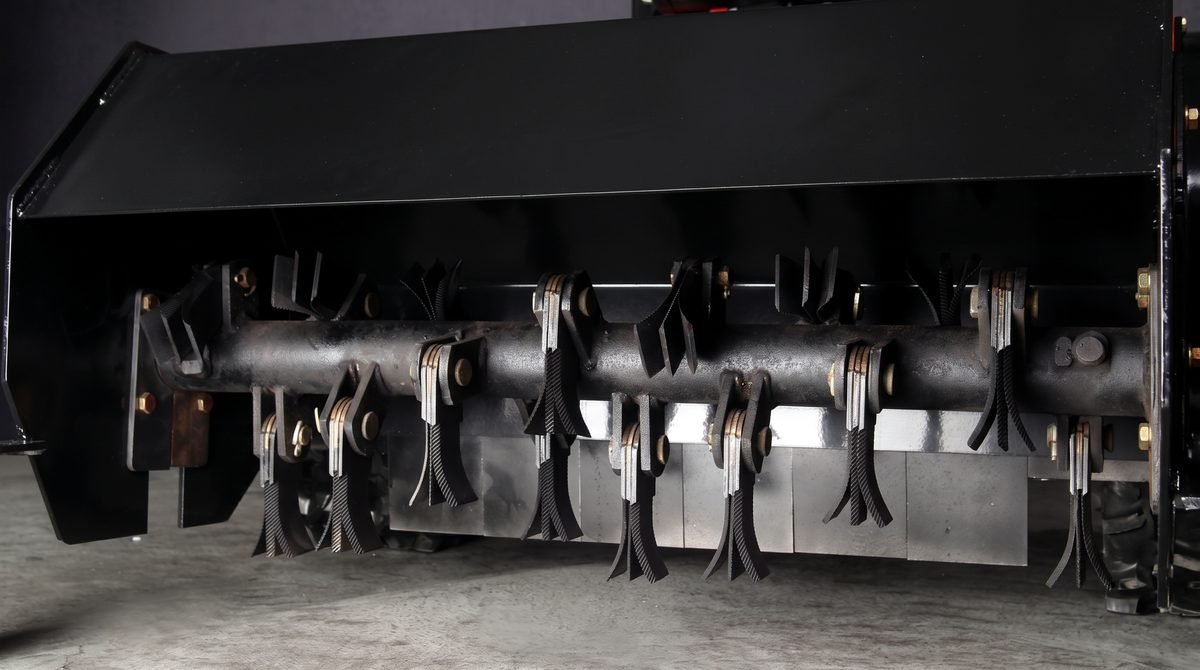
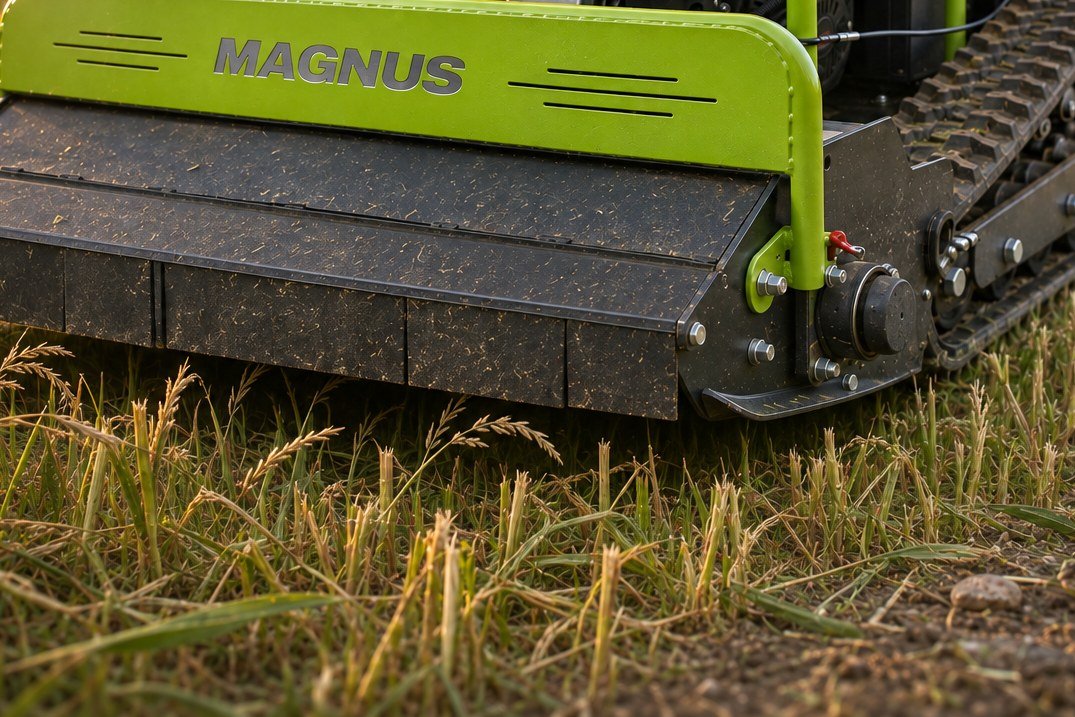
Flail: a horizontal rotor carrying 54 or 66 free-swinging blades, each shearing against a fixed counter-blade, discharging the cut material down and back as mulch.
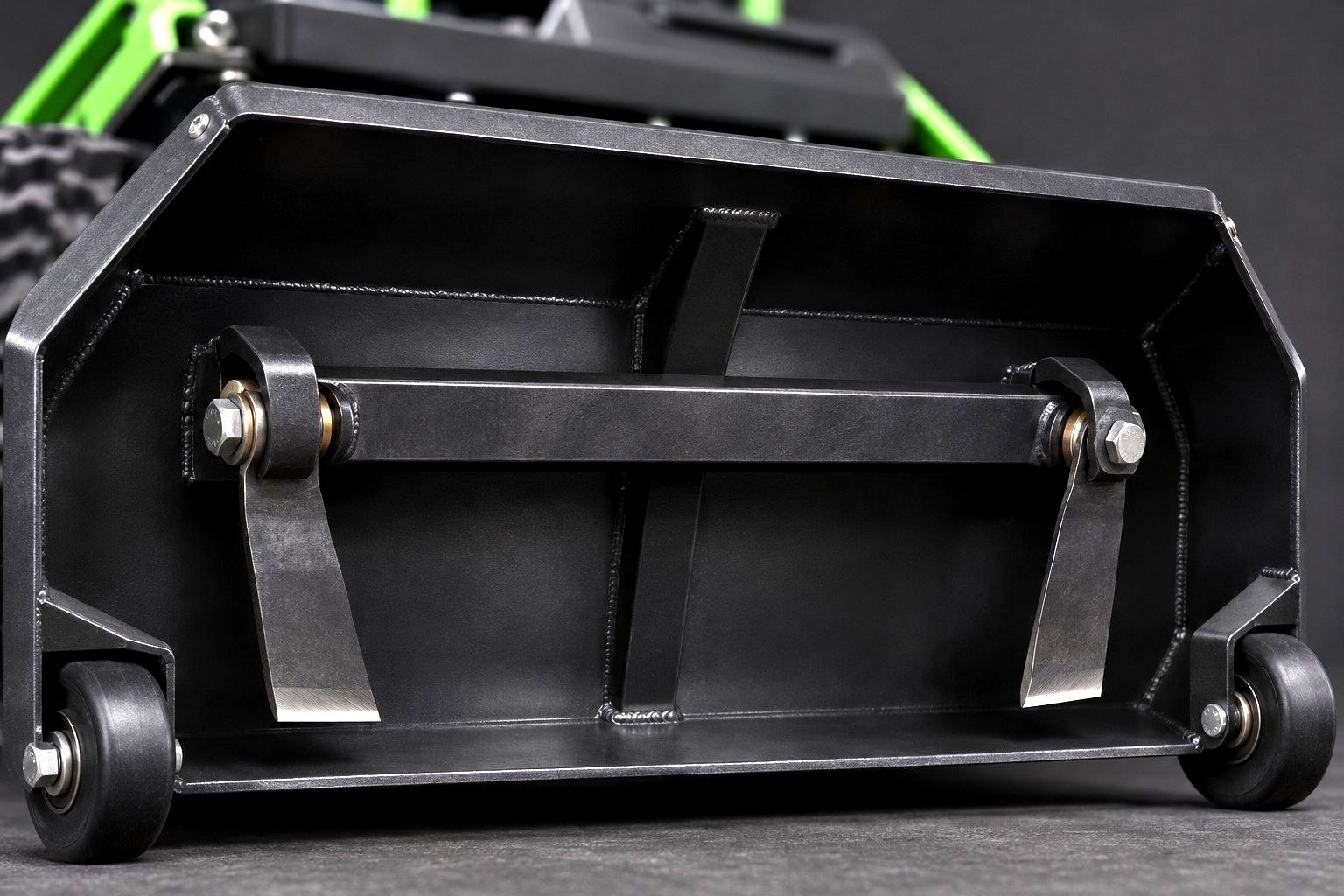
Rotary: one or two heavy blades on a vertical shaft under a dish-shaped deck, cutting by impact at the blade tip and discharging material sideways out of the deck edge.
How each deck actually cuts
A flail cuts by shear. The rotor turns inside a housing, and each blade swings out and passes a fixed counter-blade with a clearance measured in fractions of a millimetre. Material is dragged into that gap and cut once, cleanly, then held in the housing until it is small enough to fall out of the bottom. Nothing is thrown. The cut is repeated tens of times along the length of every stem, which is why the result is a mulch rather than a set of stalks.
A rotary cuts by impact. A single heavy blade, or two, sweeps under a dish and hits the stem at tip speed. It cuts on contact, and what it does not cut it bends over. The airflow under the dish lifts the material and throws it out of the side, which is why a rotary deck leaves a windrow on one side and why the operator has to think about what is standing there.
The difference in practice is not subtle. Put both decks into three-year-old bramble and the rotary will batter a path through it, leaving shredded canes that spring back within a season. The flail will reduce the same bramble to mulch and take the woody crowns with it.
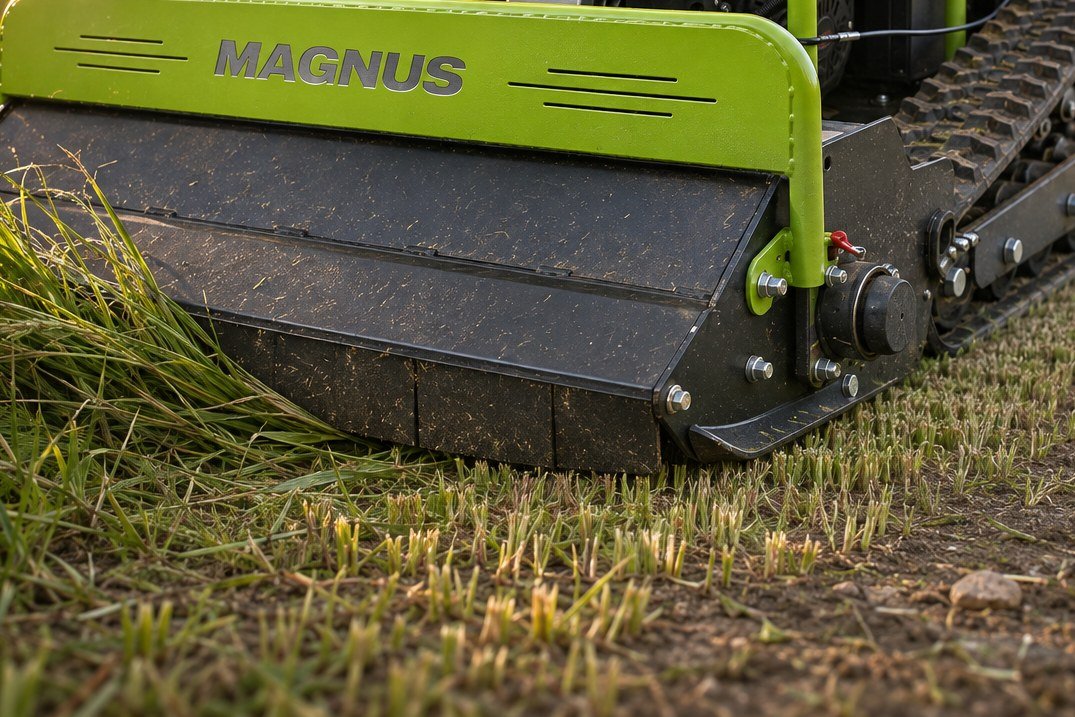
Put both decks on a maintained lawn and the order reverses. The rotary leaves a clean, even sward with a visible stripe. The flail leaves a good cut with a slightly brushed finish, because it is cutting the grass many times rather than once.
Flail and rotary, head to head
Twelve differences that decide the purchase, in the order they usually matter.
| Aspect | Flail deck (54 or 66 blade) | Rotary deck (2 blade) |
|---|---|---|
| Cutting action | Shear against a fixed counter-blade | Impact at the blade tip |
| Blade count on MAGNUS decks | 54 or 66 | 2 |
| Finish on maintained turf | Good, slightly brushed | Best in the range, clean and even |
| Bramble, gorse and regrowth | Chops and mulches, takes the woody crowns | Batters through, ragged ends, usually a second pass |
| Discharge | Down and back, contained under the deck | Sideways, several metres, in the direction of travel |
| Debris near glass, roads and buildings | Low risk, discharged down and back | The main objection to rotary decks on verges and under panels |
| Power needed for the same width | Higher, because every blade is doing work | Lower, because there is one impact per pass |
| Blades as a consumable | Many, cheap individually, replace the worn ones | Two, sharpen or swap as a pair |
| Wet or laid grass | Handles it, less clumping | Clumps and windrows, especially in long wet grass |
| Ground you have not surveyed | Preferred — a stone strike costs one blade | Strike risk on the blade and the shaft |
| Weight for the same cut | Heavier | Lighter |
| Best use | Verges, banks, solar rows, orchards, bramble and regrowth | Lawns, estates, amenity grass, mown orchard alleys |
Where rotary wins
On grass you can see. A rotary deck is faster and cheaper per metre of width on maintained turf, and it leaves the finish most customers are actually judging. If the ground is flat, the grass is short and there is nothing to hit, there is no reason to pay for a flail.
On power and weight. Two blades need less horsepower than sixty-six, so the machine is lighter, cheaper to build and cheaper to run per hour. On a small machine — our MA-50P is 140 kg with a 7 hp engine — that is the difference between a machine one person can move and one they cannot.
On the mown strip. In an orchard or a vineyard, the alley between the rows is maintained grass and the rotary deck is the right tool for it. The flail is the right tool for the headland and the ditch, which is why growers with both often run both.
Where flail wins
On ground you have not walked. A verge in February has stone, wire, cans and a broken kerb edge in it. On a flail each of those costs one blade, because the blades swing free on individual mounts. On a rotary deck the same strike goes into the blade and the shaft.
On anything woody. Bramble, gorse, broom, bracken and sapling regrowth are what a flail is for. It cuts them repeatedly until they are small enough to fall out of the bottom of the deck, and it takes the crown with them, which is why the regrowth comes back slower than after a rotary pass.
Where the discharge matters. Beside a carriageway, under a solar table, along a fence line with livestock behind it, or anywhere with glass within throwing distance. A flail throws almost nothing forward. Material is held in the housing and discharged down and back, so the deck edge is not throwing at panel height or at glass. Almost, not nothing: a stone can still leave the side of the deck. That single fact decides a large share of professional purchases.
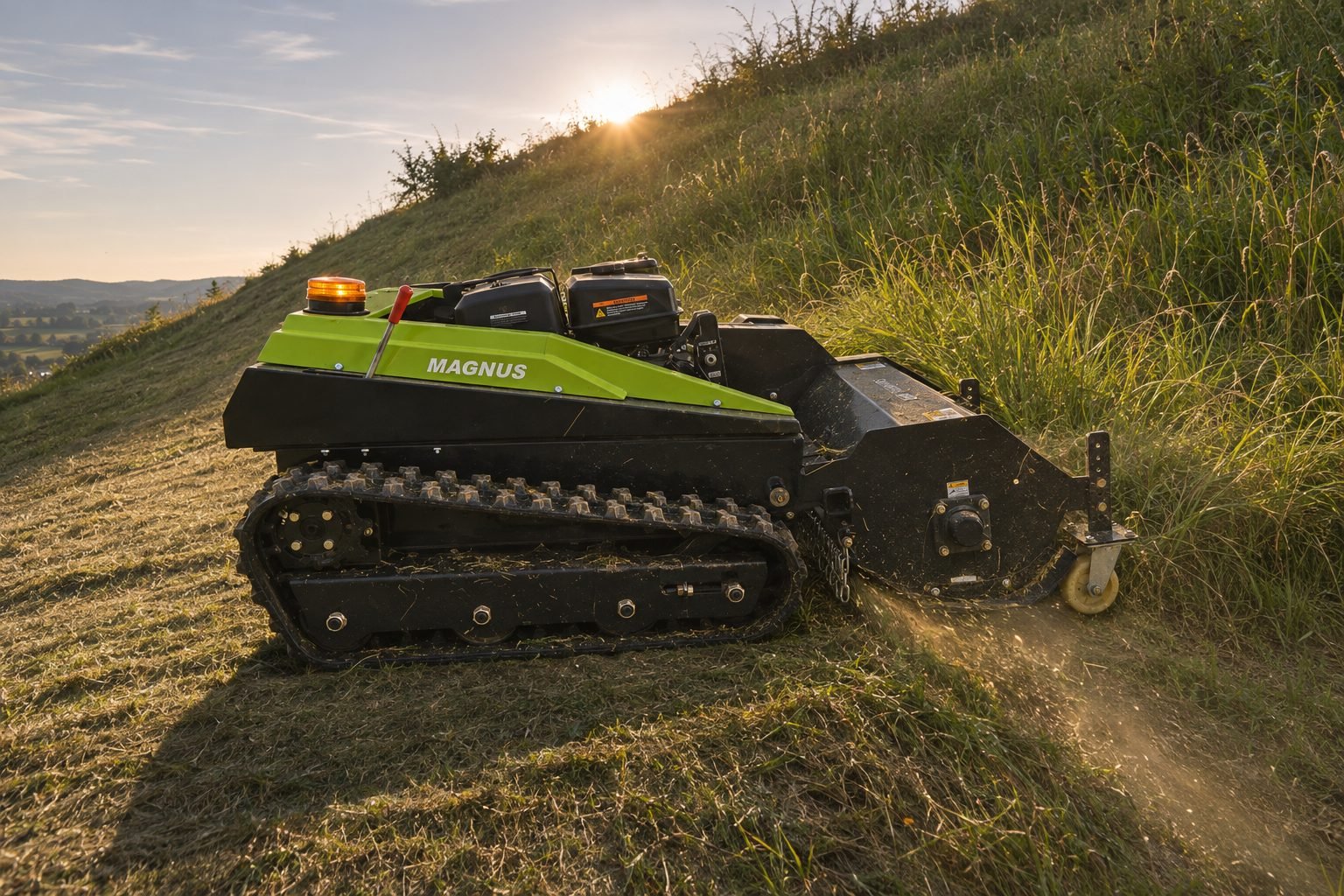
On a slope. Weight low down and material contained in the deck makes for a more predictable machine on a bank, which is why every deck we build above 800 mm is a flail.
Blade density: the number that actually decides the mulch
Blade count on its own tells you nothing. What matters is blades per metre of rotor, because that is the number of cuts a stem receives as it passes through the deck.
On our decks the two flail families come out almost identical. Fifty-four blades on an 800 mm rotor is 67.5 blades per metre. Sixty-six blades on a 1,000 mm rotor is 66 per metre. The mulch quality is effectively the same, so the choice between them is about width, weight and cut-height range — not about which one shreds better.
Against a rotary deck the difference is not marginal. Every revolution of a two-blade deck brings two blades past a given point. Every revolution of a 66-blade rotor brings sixty-six. At the same rotor speed that is thirty-three times the number of cut events, which is the entire explanation for why one deck mulches and the other one does not.
What MAGNUS builds, and why we build both
Seven tracked models across two deck families, all on the same 2.4 GHz handset and the same 45° chassis.
| Model | Deck | Blades | Cut width | Cut height | Weight | Power |
|---|---|---|---|---|---|---|
| MA-50P | Rotary | 2 | 500 mm | 30–130 mm | 140 kg | 7 hp |
| MA-80P | Rotary | 2 | 800 mm | 30–130 mm | 235 kg | 14 hp |
| MA-80-1 | Flail | 54 | 800 mm | 20–250 mm | 315 kg | 14 hp |
| MA-80-SA | Flail | 54 | 800 mm | 20–200 mm | 320 kg | 14 hp |
| MA-100 | Flail | 66 | 1,000 mm | 20–250 mm | 360 kg | 16 hp |
| MA-100-1 | Flail | 66 | 1,000 mm | 20–250 mm | 360 kg | 16 hp |
| MA-100-2 | Flail | 66 | 1,000 mm | 10–300 mm | 355 kg | 16 hp |
Every model is tracked, rated to 45° in all directions, and driven by two independent electric motors on a 200–500 m radio link. The deck families are interchangeable across the chassis, which is why a dealer can stock one platform and quote two very different jobs.
Which one for which job
Six common jobs, and the deck we quote for each. This is the short version of the conversation we have with most buyers.
- Amenity grass, flat, finish matters. Rotary. MA-80P for 800 mm, MA-50P where access is narrow.
- Roadside verges, mixed grass and bramble. Flail. MA-100-2 — widest deck and the widest cut-height range.
- Three-year-old bramble on a bank. Flail. MA-100-2, two passes, high then low.
- Orchard or vineyard alleys. Rotary for the mown strip, flail for the headland and the ditch.
- Wet banks worked across the face. Flail. MA-80-SA — lower centre of gravity, wider track stance.
- Solar inter-row and panel edge. Flail for the row, rotary low-profile for the panel edge. See mowing a solar farm.
Flail and rotary questions
Which gives a better finish, flail or rotary?
On maintained turf, rotary. Two heavy blades cut the sward once and cleanly and leave an even surface, which is why amenity mowers use that deck. A flail cuts the same grass many times as it passes through the housing, which produces a good but slightly brushed finish. On rough ground the question reverses, because a rotary cannot cut what it cannot reach cleanly and a flail will keep cutting until the material is small enough to drop through.
Which is better for saplings and regrowth?
Flail, without much argument. The blades shear against a fixed counter-blade and the material stays in the housing until it is reduced, so saplings and woody regrowth come out as mulch. A rotary deck batters stems at the tip instead, which leaves ragged ends and a stem that is bent over rather than cut. Stem diameter is a separate rating from standing height, and it is the figure to ask for on the model you shortlist.
Why does a flail need more power for the same width?
Because every blade is cutting, all the time. Sixty-six blades passing a counter-blade continuously is a much higher load than two blades sweeping through free air once per revolution. That is why our 1,000 mm flail decks carry 16 hp while the 800 mm rotary deck manages on 14 hp, and why the flail machines are heavier. The power goes into the cut rather than into throwing the material out of the side.
Is a flail harder to maintain?
It has more parts, but the parts are cheaper and individually replaceable. Sixty-six blades sound like a maintenance burden until you compare it with replacing a bent rotary blade and a damaged shaft after a stone strike. On a flail you replace the blades that are worn and leave the rest. The bearings and the counter-blade are the items to check on a service interval, and both are accessible without removing the deck.
Can a rotary mower cut bramble?
It can, and people do it, but the result is a battered path rather than a cleared one. The canes are cut where the blade reaches them and left ragged where it does not, and the crowns survive. Bramble cut that way comes back within a season. The flail takes the crown with the stem, which is why the regrowth interval is longer and why contractors doing repeat work on the same ground specify flail.
Which is safer next to a road or under a solar array?
The flail, because it discharges down and back instead of sideways. A rotary deck throws cut material several metres out of the side of the housing in the direction of travel, and on a verge that means the carriageway. Under a solar table it means the panel edge and the combiner boxes. If the site has glass, traffic or livestock within throwing distance, that alone usually settles the choice.
Does blade count matter as much as people say?
Between flail decks, no. Our 54-blade 800 mm rotor works out at 67.5 blades per metre and our 66-blade 1,000 mm rotor at 66 per metre, so the mulch quality is effectively the same and the real difference is width and weight. Between a flail and a two-blade rotary the difference is enormous, because two blades per revolution against sixty-six is not a variation in quality, it is a different method of cutting.
Which costs more to run over a season?
It depends on what you are cutting rather than on the deck. On clean amenity grass the rotary is cheaper: less power, lighter machine, two blades to sharpen. On bramble and verge work the flail usually wins on total cost, because one pass replaces two and the blade bill is a set of cheap items rather than a shaft. Price the passes, not the deck, and the answer usually becomes obvious.
Not sure which deck your ground needs?
Send a photograph of the site and tell us what is growing on it. You get a deck recommendation with the reason, and FOB, CIF and DDP pricing for that machine — normally within one working day.