Utility-scale PV vegetation management
A remote control mower for solar farms
Solar sites fail on vegetation for three reasons: the row is too narrow for a tractor, the panel edge is too low for a ride-on, and nobody wants a strimming crew walking between live arrays. A tracked remote control mower answers all three — 630 mm low-profile decks, 500 mm to 1,000 mm cuts, rated to 45°.
Why a solar site is not a lawn
A solar array is a machine yard with grass growing through it. The constraints that matter are structural, not horticultural, and each one rules out a machine that would be perfectly adequate on open ground.
The row is narrower than the equipment. Fixed-tilt rows are commonly 2.5–4 m apart. Single-axis trackers need more room again, because the table swings and the torque tube sits at ankle height along the centre line. A compact tractor with a 1.8 m deck does not fit, and neither does the operator’s nerve.
The panel edge is low. On fixed tilt the low edge usually sits 0.6–1.0 m off the ground. Anything taller than that cannot work the panel edge, which is exactly where the vegetation matters most, because that is where the shading starts.
The inter-row is full of services. Cable trenches, combiner boxes, earthing straps, ballast and drainage all live in the same strip you want to mow. A deck that throws material sideways throws it at a combiner box.
Nobody wants to walk it. Between live DC strings, a strimming crew is a risk assessment that gets harder every year, and the labour is the largest line in the vegetation budget.
The figures above are typical of utility-scale layouts rather than universal. Check the as-built drawings for the site you are pricing — row pitch, panel low-edge height and pile positions decide the machine more than the acreage does.
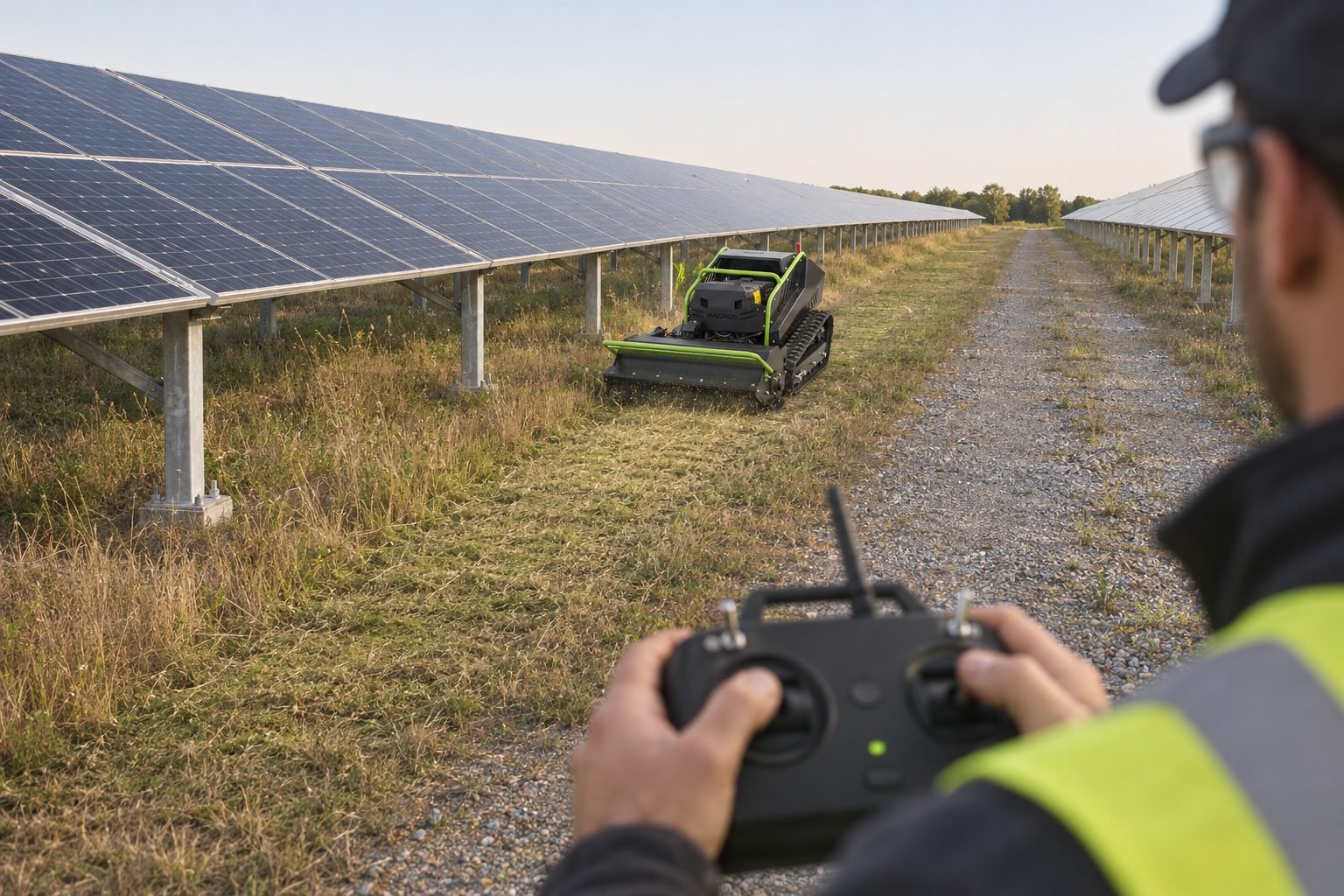
Three zones, three different machines
A solar site is not one mowing job. The perimeter, the inter-row and the panel edge each rule out a different machine, which is why single-machine fleets usually end up with the wrong compromise.
| Zone | What constrains it | Deck that fits |
|---|---|---|
| Perimeter and security strip | Open ground, often a steep bund or a drainage bank, sometimes a public footpath alongside | MA-100-2 or MA-100 — a metre of flail deck and 16 hp |
| Inter-row, between tables | Overall width against piles and torque tubes; turning space at the row end | MA-80-1 at 1,020 mm overall, or MA-100 at 1,180 mm |
| Panel edge and around piles | Machine height against the low edge of the table; no side discharge onto glass | MA-50P or MA-80P — 630 mm tall, two-blade rotary |
| Inverter stations and cable routes | Tight, flat, and a finish the client actually looks at | MA-50P — 500 mm cut, 140 kg, 1,030 mm wide |
| Steep bunds and attenuation basins | Ground a ride-on cannot hold; often wet at the base | MA-80-SA — lower centre of gravity, wider track stance |
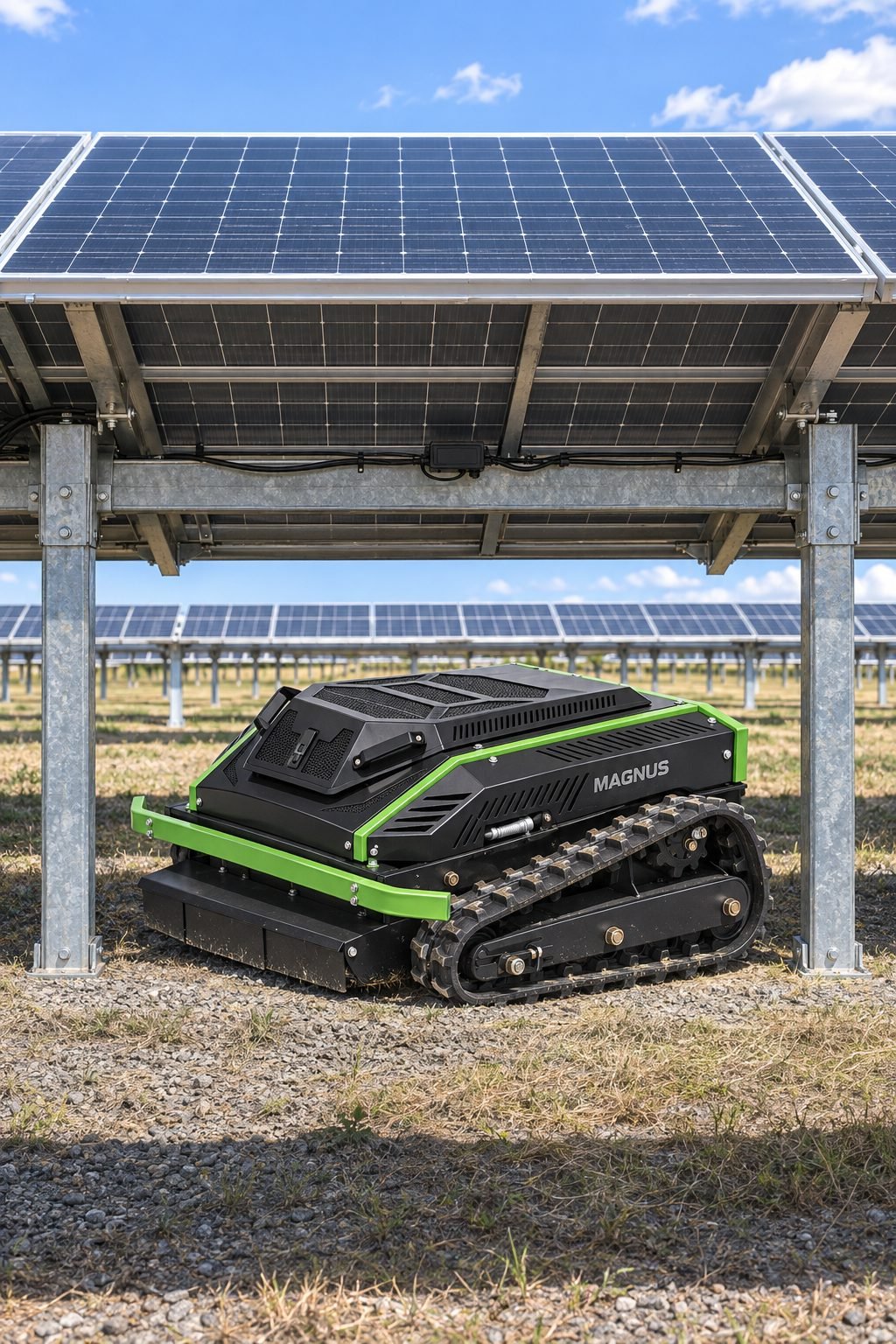
Clearance is the whole specification
The panel table sets a hard ceiling and the piles set a hard width. A machine that clears both is the only one that can work the strip that actually causes shading, and no amount of engine power compensates for 30 mm too much height.
This is why we publish overall height and overall width alongside the cut width, and why the first two questions we ask about a solar site are the row pitch and the panel low-edge height.
- Panel low edge to ground, measured at the lowest point of the table. Sag, build-up and a settling row all vary along a single span, so the average is the wrong figure to design against.
- Clear width between pile faces, not centre to centre. A pile is 100 to 150 mm across and the machine has to pass the faces, not the grid lines on the drawing.
- Then take 50 mm off each figure before you choose. Clearance that only works on the drawing is not clearance. The 50 mm is the margin for a rut, a wind-blown ridge of soil or a mower coming back the other way.
The four numbers that decide the machine
Most solar enquiries arrive as a site area in hectares and a photograph. Neither of those picks the machine. These four figures do, and all four are on the layout drawing you already have.
1. Overall width. The MA-80P and the MA-80-1 cut the same 800 mm, but the MA-80P is 1,300 mm wide across the deck while the MA-80-1 is 1,020 mm. On a tight row the narrower machine works and the wider one does not, even though the cut is identical. This is the single most common specification error we see.
2. Overall height. 630 mm for the MA-50P and MA-80P, 730 mm for the MA-80-SA and 750 mm for the flail decks. Height decides whether you can work the panel edge or only the middle of the row.
3. Weight. 140 kg to 360 kg across the range. On ballast, on a root zone and over a cable trench, weight is the constraint rather than power.
4. Radio range. 200–500 m depending on obstructions. A 20 ha site is roughly 450 m across, so on the larger arrays the operator works from a corner rather than following the machine.
Ground pressure, ballast and the root zone
Vegetation on a solar site is not decoration. Roots hold the ballast shoulder together, stabilise the bund and keep the drainage working. Compaction is the thing to avoid, and it is a function of ground pressure rather than of total weight.
Tracks spread load along their whole length instead of concentrating it at four wheel contact patches. A 360 kg tracked machine and a 1.5 t compact tractor are not in the same category on a cable route, and that is before anyone talks about the deck.
The second reason tracks matter here is turning. A wheeled machine scrubs its rear axle when it turns, and on a ballast strip that scrub is what pulls the stone off the shoulder. A tracked machine counter-rotates in its own length.
Fire risk is a mowing schedule, not a mower
Dry grass under a panel is fuel load, and the panel above it is the thing that makes a small fire expensive. Most O&M contracts therefore set a maximum award height rather than a mowing frequency — 150 mm is a common figure — and leave you to work out how many passes that takes.
The arithmetic is straightforward once you accept it. A 1,000 mm deck at 3 km/h covers 3,000 m² of ground per hour at full theoretical efficiency. A 20 ha site is 200,000 m², so one complete pass is 67 machine-hours. In the inter-row, with row ends, pile work and turning, expect to achieve around half of the theoretical figure, which puts a single pass at roughly 130 hours — about three weeks for one machine at six productive hours a day.
That number, not the hectare figure, is what tells you how many machines the site needs. Two passes a year on 20 ha is six machine-weeks. One machine does it if the season is long enough; two machines do it inside a six-week window before the dry season starts.
Every model, measured the way a solar site needs it
Overall width and overall height first, because those are the two dimensions the array actually constrains. Cut width is third.
| Model | Overall width | Height | Cut width | Weight | Power | Deck |
|---|---|---|---|---|---|---|
| MA-50P | 1,030 mm | 630 mm | 500 mm | 140 kg | 7 hp | Two-blade rotary |
| MA-80P | 1,300 mm | 630 mm | 800 mm | 235 kg | 14 hp | Two-blade rotary |
| MA-80-1 | 1,020 mm | 750 mm | 800 mm | 315 kg | 14 hp | 54-blade flail |
| MA-80-SA | 1,020 mm | 730 mm | 800 mm | 320 kg | 14 hp | 54-blade flail |
| MA-100 | 1,180 mm | 750 mm | 1,000 mm | 360 kg | 16 hp | 66-blade flail |
| MA-100-1 | 1,180 mm | 750 mm | 1,000 mm | 360 kg | 16 hp | 66-blade flail |
| MA-100-2 | 1,180 mm | 750 mm | 1,000 mm | 355 kg | 16 hp | 66-blade flail |
All seven models share the same 2.4 GHz proportional handset, the same 200–500 m radio link and the same 45° slope rating in all directions. Dimensions are overall, not deck-only. If your row is tighter than 1,020 mm, tell us — the deck is the wrong shape for the site and no amount of specification will fix it.
What to put in the RFQ
Solar procurement usually runs through an EPC or an O&M contractor, and the specification is written once and reused. These eight items are what separates a quotation you can compare from one you cannot.
If you send nothing else, send the row pitch and the panel low-edge height. Those two figures eliminate most of the market before anyone discusses price.
Solar farm mowing questions
Will it fit between our rows?
That depends on the clear gap between pile faces rather than on the nominal row pitch, and the narrowest machine in the range is 1,020 mm across the tracks. Send us the gap and the pile layout and we will tell you which models pass and which do not. If the answer is that none of them pass, we will say so rather than sell you a machine that gets stuck at the first row.
Can it mow under the panels, or only between the rows?
Under the panel edge, yes, on the low-profile decks. The MA-50P and MA-80P are 630 mm tall overall, which clears a typical fixed-tilt low edge. Working the full width under a table is not what these machines do — the panel is in the way of the operator’s view and of the radio signal. What they do is keep the edge clear, which is where shading actually starts.
Does the discharge damage the panels?
A flail deck discharges cut material down and back under the machine, so very little leaves the deck upward toward glass. It is not nothing: debris can still leave the deck edge sideways, and a stone caught at the wrong angle will travel. That is one of the reasons we specify flail decks for inter-row work rather than a rotary deck, which throws material sideways out of the deck edge and would send it at the piles and the combiner boxes. If the array has a low tracker in the horizontal position, keep the deck out from under it regardless.
What happens to the radio signal between rows?
The handset is rated for 200–500 m depending on obstructions, and steel piles and panel tables are obstructions. In practice the operator works from the row end or the access track rather than walking the row, which keeps the machine in line of sight for most of the pass. On a large array the working pattern is a series of row-length runs, not one continuous sweep. A range extender is available where the site geometry demands it.
Is it safe around live DC strings?
The machine is petrol-powered, a Loncin engine of 224 to 459 cc depending on deck width, with a radio handset, so there is no trailing cable and no operator in contact with the array. Two risks matter here and neither cancels the other. Mechanical: striking a pile, a combiner box or a cable cover. Electrical: a damaged DC string, which at string voltage is the one that kills. Set the cut height so the deck clears the cable cover depth on your site, and mark the combiner positions before the first pass. Your own risk assessment governs, and we will supply the machine documentation it needs.
How many machines does a site of our size need?
Work it from the pass time rather than from the area. A 1,000 mm deck at 3 km/h covers 3,000 m² per hour theoretically, and roughly half that in real inter-row conditions. Divide your area by that figure to get hours per pass, then divide by the hours in your weather window. Two passes a year is the usual contract, so the number of machines falls out of the window rather than out of the acreage.
Can we buy a fleet under our own brand?
Yes. Colour, decal and manual can carry your label, and a colour and decal change does not require new tooling. O&M contractors running mixed fleets usually standardise on one handset and one blade type across the machines, which is worth specifying at order stage rather than after delivery. See the dealer programme for terms.
What does a machine cost, delivered?
We quote per order rather than publishing a list price, because deck, engine, radio package and freight terms move the number more than the model does. Send the site details and the volume and you get FOB Qingdao, CIF and DDP side by side, so the landed cost per machine is visible before you commit. For a fleet, ask for the container loading plan as well — it usually changes the DDP figure.
Send the row drawing, get a machine
Send the row pitch, the panel low-edge height and the site area. You get a model recommendation with the reason it fits, and FOB, CIF and DDP pricing — normally within one working day.